


By Vivify Mariposa 🦋 No Filter. Just Facts.
The Machine Series
A friend told me the left only controlled the Dominican Republic one time. I told him he was wrong. He told me to check the history. So I checked it.
But I was not checking history like someone trying to win a cute little political argument over coffee. I was checking the machinery behind the words he was using.
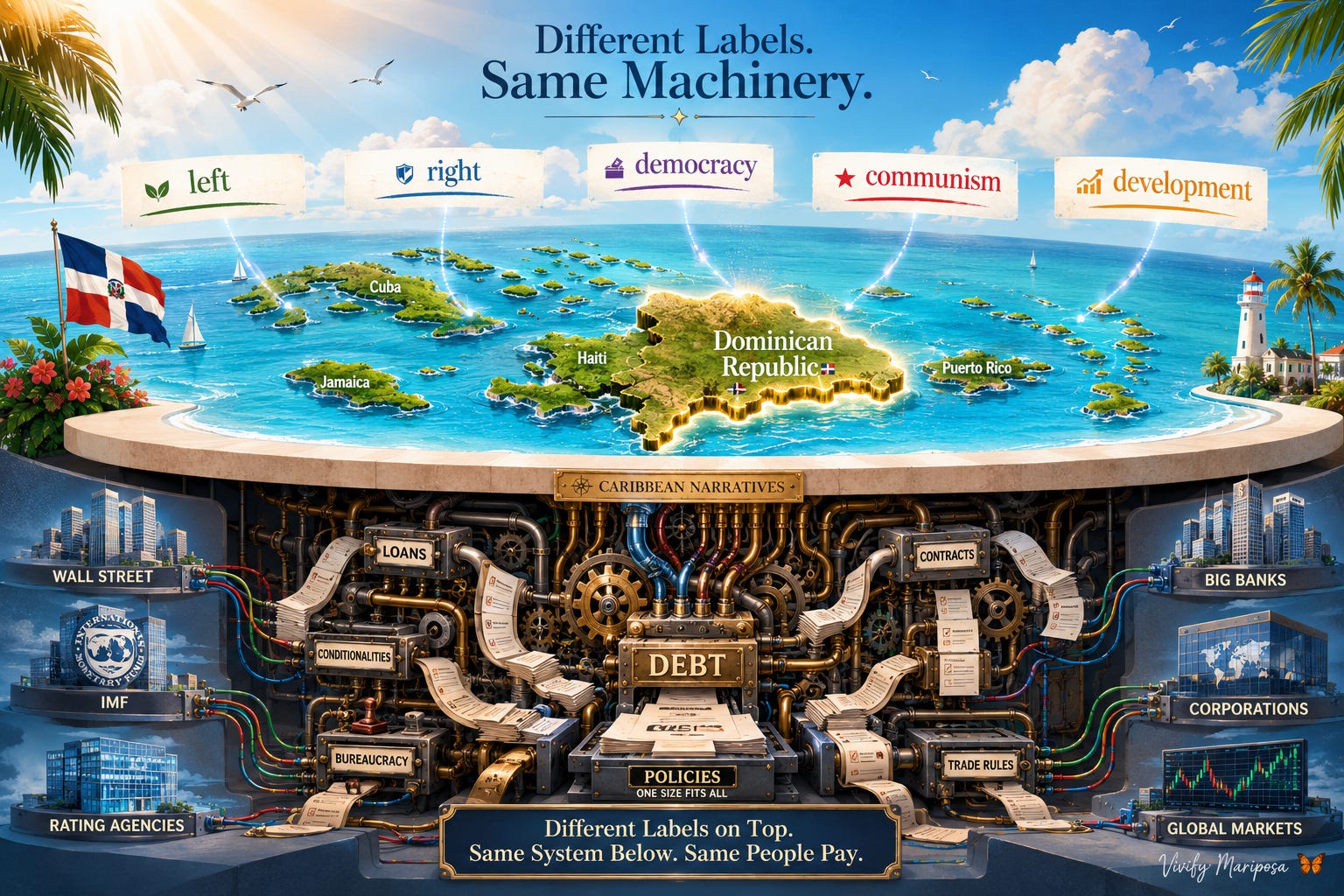
I focus on Dominican Republic because that is where I am from. This is not a random case study I pulled from a map. I know how Dominicans talk about politics. I know how people repeat party labels like they are facts. I know how fast someone will say the left or the right without ever asking who gave them those definitions in the first place.
I saw the same machinery operating in real time on X.
A Dominican man tried to tell me that the Dominican Republic was never a Spanish colony because “this was Spain.” That sentence alone explains the problem. That is not history. That is colonial language still living inside the mouth of someone who thinks repetition is knowledge.
When the argument started collapsing, he did what people do when the words run out. He called me progressive. Then globalist. Then Agenda 2030. Because once the mind cannot follow the structure, it grabs a label and throws it like a rock.
That is exactly how the machine works.
It teaches people to defend old empires while pretending they are defending history. It teaches them to hate Haiti while defending Spain, as if both powers did not use the island in different ways. It teaches them to scream communist, progressive, or globalist whenever someone asks who owns the land, who controls the debt, who writes the laws, who funds the parties, and where the money goes after the flag is waved.
That is why the Dominican Republic is not a side example in this series. It is the operating room. I am not studying this from a distance. I have watched people confuse inherited vocabulary with historical knowledge. I have watched Dominicans defend the language of the old colonizer while missing the structure of the new one.
They think colonization ended because there is no crown and no viceroy.
That is the joke.
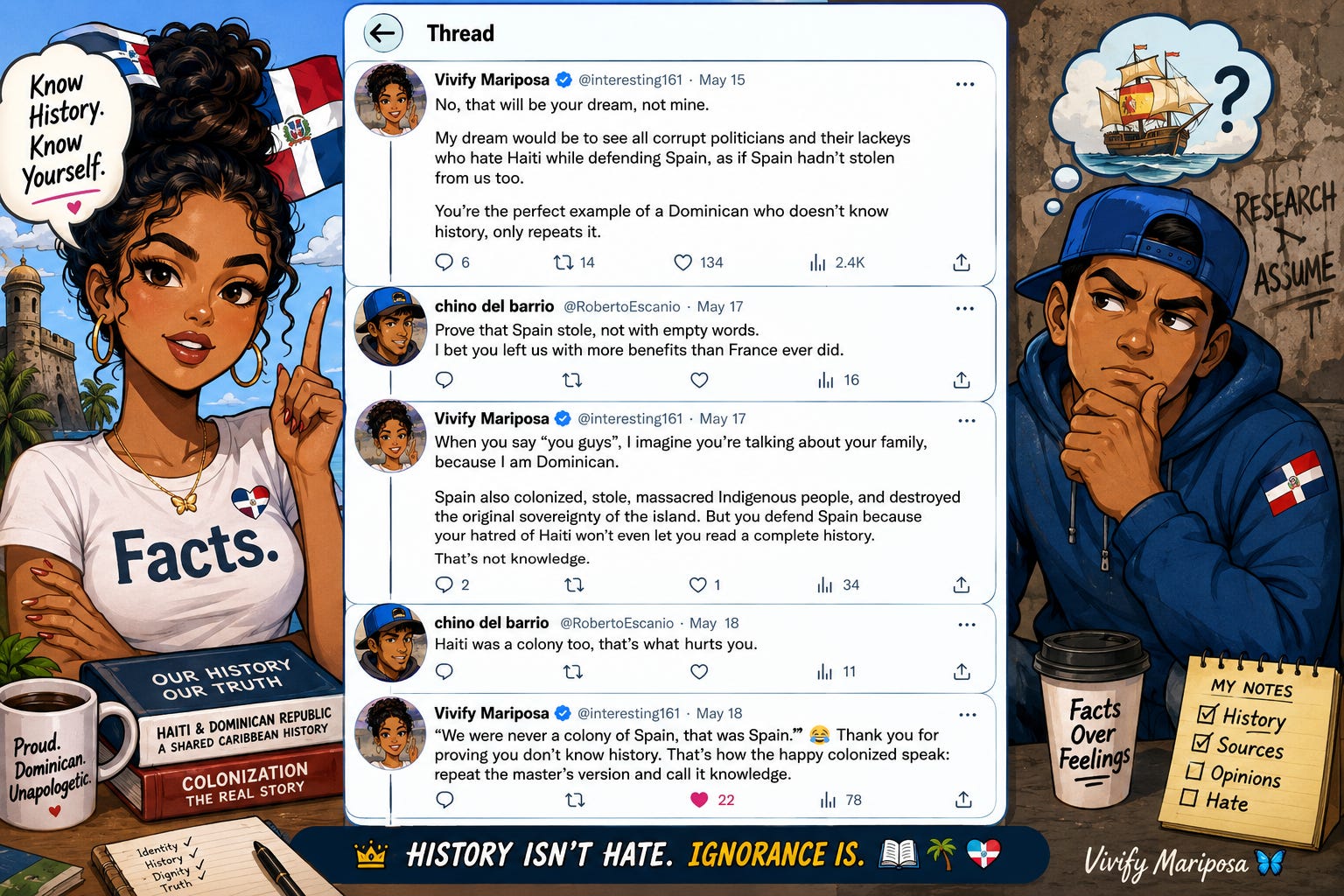
The crown changed into credit. The viceroy changed into the IMF. The colonial office changed into international institutions, NGOs, development banks, bond markets, party machinery, constitutional reforms, and politicians who sell sovereignty one agreement at a time.
The uniform changed.
The structure did not.
I have watched people confuse party loyalty with political knowledge for my entire life. I have watched people think right means rich people, elite families, Balaguer, church power, military order, and business protection. I have watched people think left means only Cuba, Castro, guerrillas, red flags, and communism in the hard form.
That confusion is not accidental. It is the result of a machine that changed the language so deeply that people cannot recognize soft communism when it arrives dressed as democracy, social rights, state responsibility, constitutional promises, public dependency, taxation, regulation, debt, IMF conditions, and party control.
And it is still happening.
In 2026, the Dominican political class made the mask even clearer. Law 13-26 eliminated independent candidacies and reserved electoral participation to parties, groups, and political movements. In plain language, the same party system that claims to represent democracy now controls who is allowed to enter the election structure. The citizen can vote. The machine decides who gets to stand at the gate.
That is not freedom. That is managed participation with a ballot box attached.
That is democracy after the dictionary has been rewritten: participation allowed only after the party structure approves the participant.
The law passed. The political class kept calling it democracy. Nobody stopped calling it democracy. The word did not change. The meaning underneath it had already been emptied years before.
So when my friend said the left only governed once, he was not only making a mistake about Dominican political history. He was showing what the machine had already done to the language. He was looking for the monster he had been trained to fear and missing the medicine that had already entered his bloodstream.
The machine built two products for the Caribbean. Communism as the monster. Democracy as the medicine. The monster scared populations into demanding the medicine. The medicine delivered the same control structure through softer language, slower mechanisms, and a more patient timeline. The Caribbean is where you can watch both products operating simultaneously on the same islands, in the same generation, on the same commodity, with the bills still arriving.
The Dictionary Came Before the Debt
Before the first IMF loan officer landed at a Caribbean airport and before the first structural adjustment condition was written, the machine worked on the vocabulary. This is the operation that makes everything else possible. You do not need to explain a debt to a population if the population does not have accurate words to describe what is happening to it.
Republic is not the same word as democracy. It has not been the same word since the ancient world but the machine collapsed them into synonyms and the collapsing did specific work.
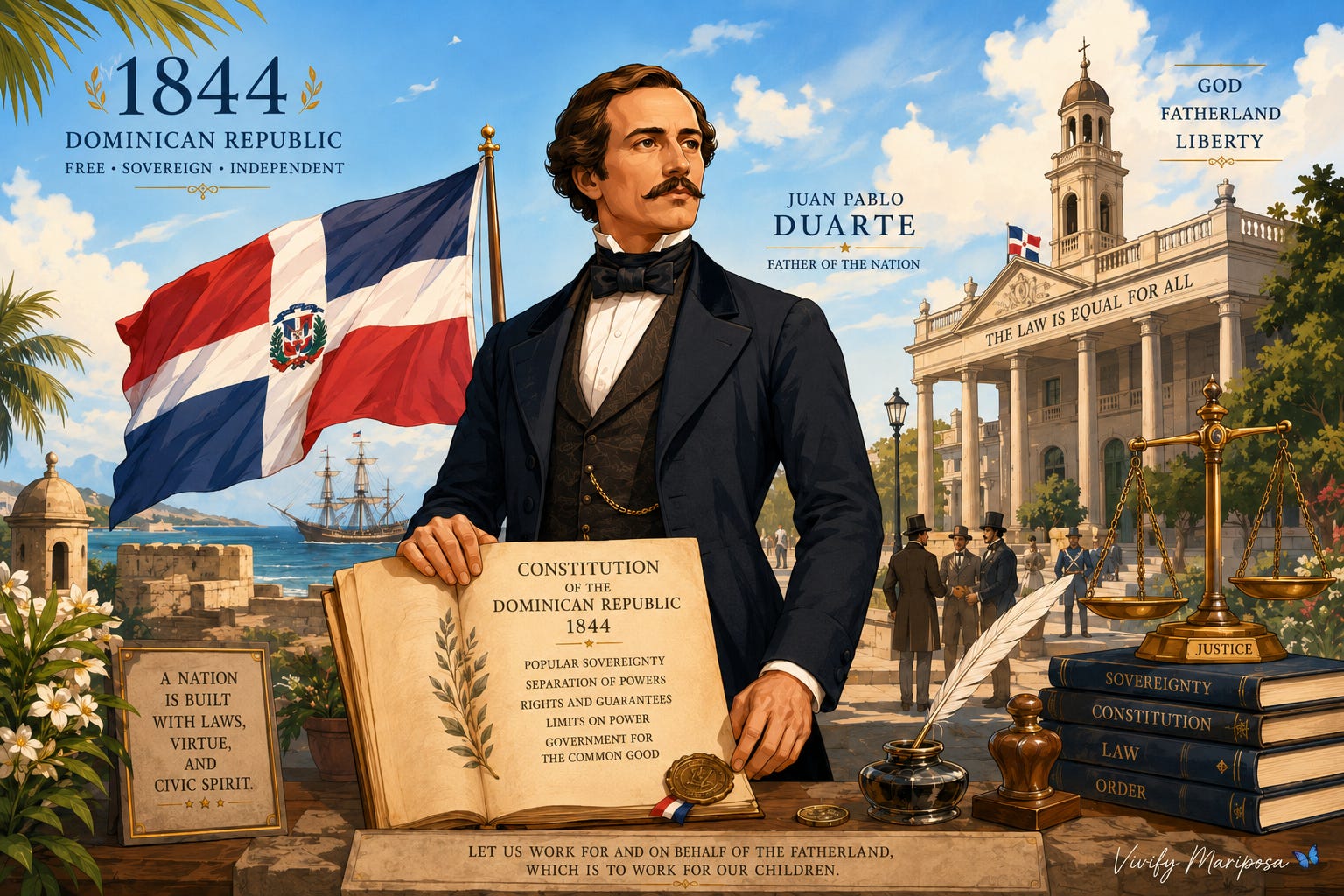
A republic limits what government can do. The rights precede the state. The constitution restrains power. The individual has protections the government cannot override regardless of majority opinion or emergency. Government derives its authority from the consent of the governed and operates within defined boundaries. The state cannot expand without explicit authorization. That is the 1844 Dominican framework.
A social democratic state promises what it will provide. Rights are things the state creates, defines, and delivers. The population becomes dependent on government delivery of services. The state grows to meet its obligations. Every new constitutional right requires revenue, which requires borrowing, which requires bond market access, which requires credit ratings, which requires IMF Article IV compliance, which requires fiscal behavior the IMF approves. The constitutional promise and the financial constraint arrive as a package.
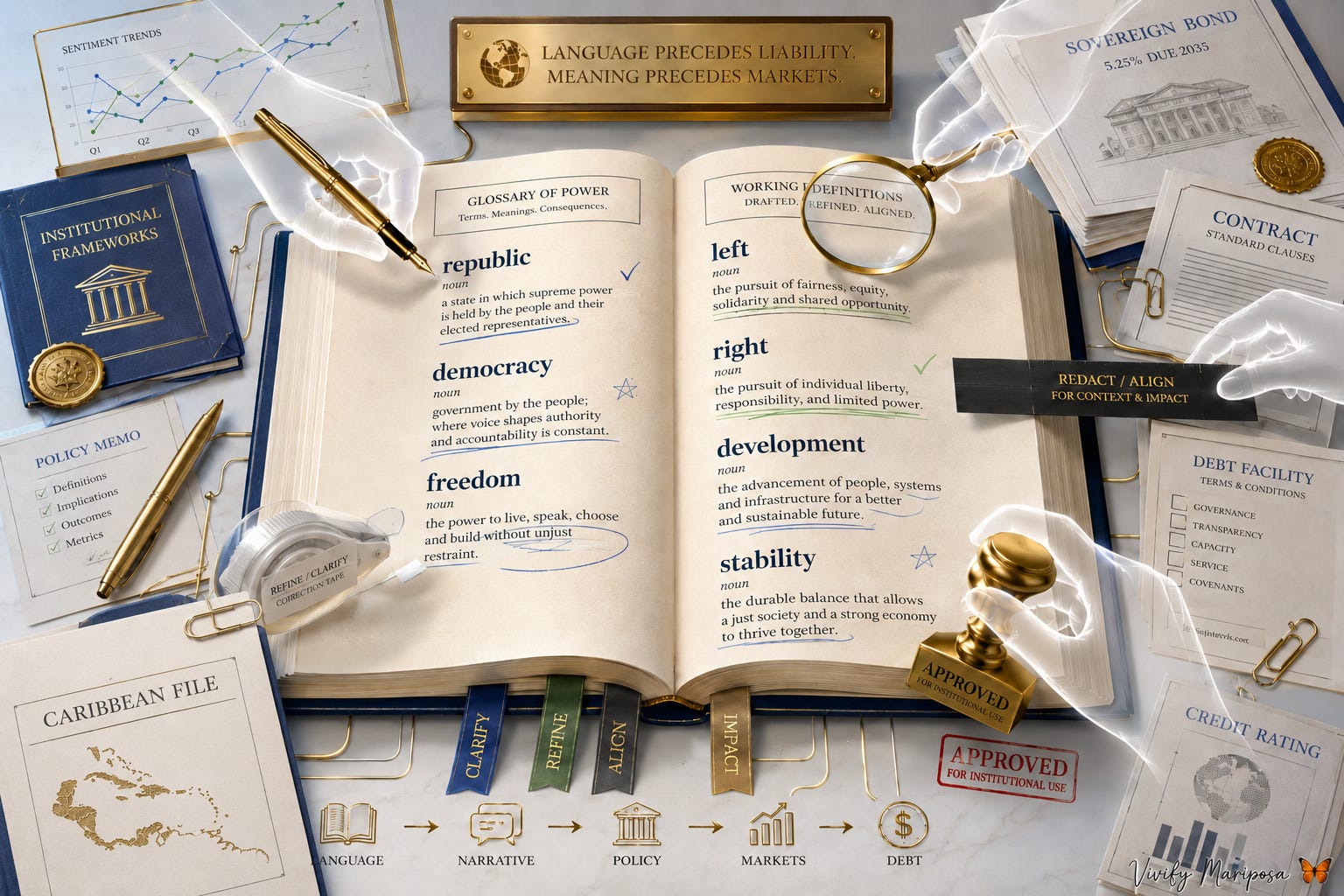
Left and right became costumes for the same financial compliance. In the Dominican Republic and across the Caribbean, left no longer means workers controlling the means of production, determining their labor conditions, owning their land, or directing their export revenue. Left means a party that uses social language and expands state programs that create dependency on the state apparatus the creditor architecture controls. Right no longer means limited government, individual sovereignty, and freedom from state interference. Right means a party that uses conservative language and emphasizes fiscal discipline while maintaining the same bond market access and IMF compliance as the left.
Neither describes an alternative to the financial architecture. Both describe stylistic differences in how governments manage it.
Communism became the word that ended conversations. Not because communist governments were uniformly benevolent. Some were genuinely repressive. But the word was applied far beyond its accurate use to describe any government that threatened the extraction architecture regardless of its actual political structure. The label did not identify the political system. It identified the government’s relationship to the creditor machine. A government that stayed inside the system was called democratic. A government that tried to leave was called communist. The label followed the financial decision, not the political one.
Democracy became the word that opened credit lines. A government that called itself democratic and held elections received IMF program access, World Bank development lending, IDB financing, and U.S. diplomatic support regardless of what it did to the working class inside its borders. The Dominican Republic under Balaguer, with documented death squads and hundreds of assassinated political opponents, received continuous U.S. support and maintained its democratic designation throughout. The word protected the relationship. The relationship protected the extraction.
Development meant the state’s economy was being restructured to service external debt while the population was told the restructuring was for their benefit. Stability meant the government was complying with the creditor architecture. Reform meant austerity delivered in installments. Social justice meant constitutional language that expanded state obligations while the IMF contracted the fiscal space to fulfill them.
Once the vocabulary was in place, the rest of the operation could run with minimal resistance. People cannot organize against a system they cannot accurately name.
1844: What the Dominican Republic Was Built to Be
The Dominican Republic declared independence on February 27, 1844. The founding was led by Juan Pablo Duarte, a man who understood exactly what a republic meant and wrote the framework deliberately. The first constitution was signed that same year. The country organized itself as a republic. Government power limited. Rights preceding the state. Sovereignty resting with the people.
That framework was immediately contested. Not by ideology. By power.
Pedro Santana, the country’s first president, repeatedly sought to surrender Dominican sovereignty to external powers. In 1861 he formally annexed the country back to Spain. The Restoration War began in 1863. Independence was restored in 1865. The republic was restored. It did not survive the next arrangement without challenge.
By the early 1900s the Dominican Republic was in debt to the United States. When it could not repay, President Theodore Roosevelt appointed an American receiver of Dominican customs in 1905. Dominican port revenue went to American collectors to service the debt. The republic’s most fundamental fiscal function, collecting its own taxes, was administered by a foreign government because of debt.
In 1916 the United States established a full military government in the Dominican Republic. The Dominican government was suspended. U.S. Marines issued governmental regulations in substitution of Dominican law. This ran until 1924. The republic’s flag existed. The republic’s sovereignty did not.
Since 1844 the Dominican Republic has had 38 constitutions. Every incoming government wrote its own. Not because the founding principles changed. Because each new power arrangement needed a legal document that legitimized it. The constitution became the instrument through which external requirements were domesticated into Dominican law. Every time the power arrangement shifted, the constitution shifted with it.
By the time the 2010 reform arrived, the instrument had been used 38 times.
A republic cannot protect people when every power arrangement gets to rewrite what the republic means.
1963: The Seven Months That Showed the System
Juan Bosch won the Dominican Republic’s first free election in December 1962. He took office on February 27, 1963. The date mattered. It was the 119th anniversary of Dominican independence. Bosch understood the symbolism. He had spent 24 years in exile. He had founded the Dominican Revolutionary Party in 1939 from abroad. He had waited for the moment when Dominicans could govern themselves freely.
His constitution was the most genuinely republican document the Dominican Republic had produced since 1844. It protected workers. It restricted large landholdings, the latifundia system that had concentrated agricultural wealth in the hands of a small class for generations. It was secular. It limited military power. It did not nationalize industry. It did not expropriate foreign assets. It established civil liberties. It extended voting rights. It was, by any honest reading, a liberal democratic constitution in the classical sense.
Four groups read it as a threat.
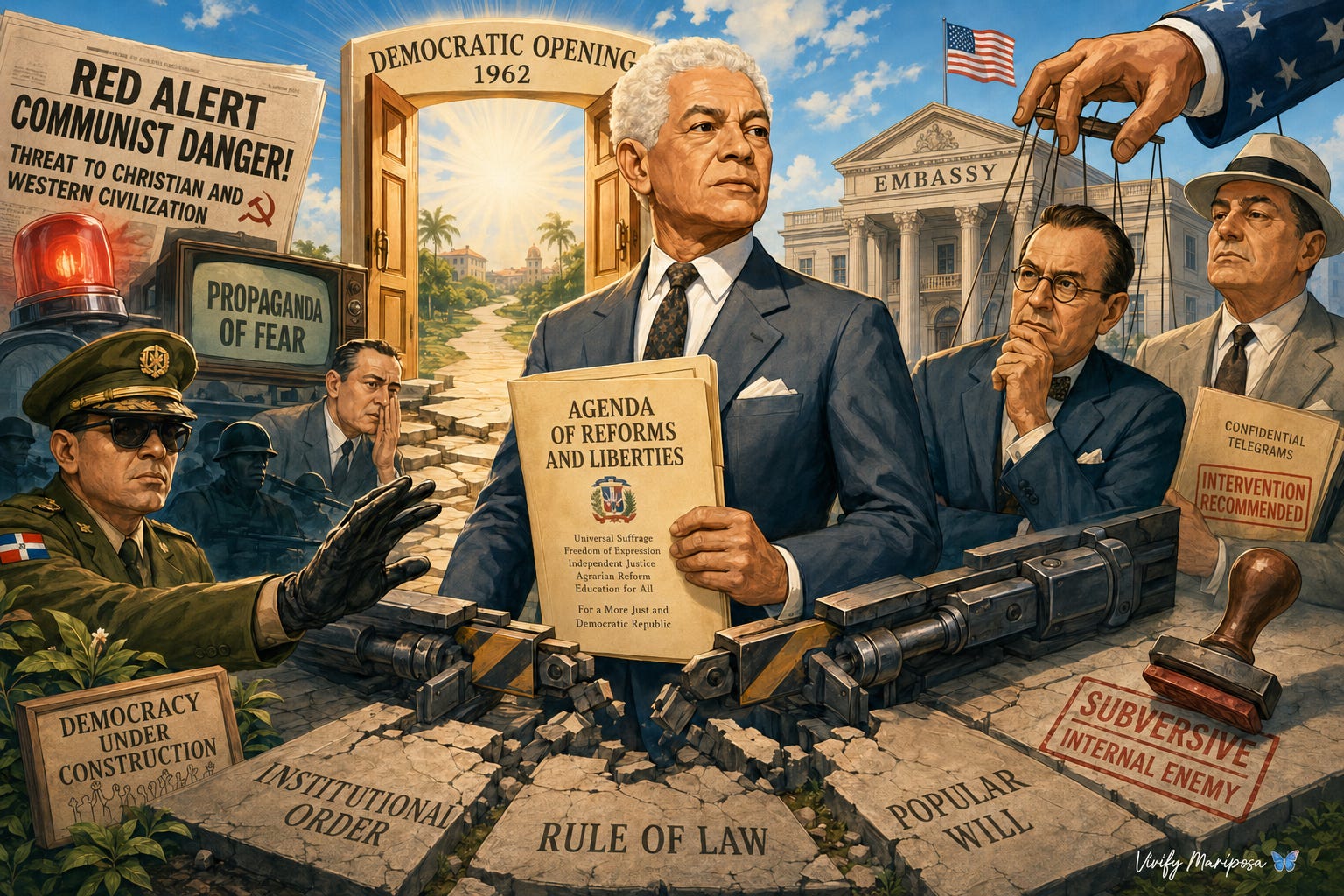
The landowners were frightened by the restrictions on latifundia. The Catholic Church was angered by the secular provisions. The military read the limitations on its power as an attack on its institutional position. The U.S. ambassador fed damaging reports to Washington describing the new government as communist-infiltrated based on the presence of so called “left-wing figures” in Dominican public life and Bosch’s refusal to ban the Communist Party. Bosch refused the ban on constitutional grounds. He said Dominicans had the right to hold political opinions. The ambassador read that as communist sympathy.
The military spent weeks spreading the communist accusation before acting. The rumor was the infrastructure. It established the justification before the coup needed to be explained. On September 25, 1963, General Elias Wessin y Wessin led twenty-five senior military commanders in removing Bosch from office. The coup was bloodless. Bosch was placed under arrest and sent into exile in Puerto Rico. He had governed for seven months.
In April 1965 Constitutionalist forces, a combination of military officers and civilians loyal to the 1963 constitution, launched a revolt and restored constitutional order in Santo Domingo. The rebellion was described by the U.S. Embassy as a “left-wing attack”. The description was sent to Washington. It shaped every decision that followed.
President Lyndon Johnson sent 22,000 troops. The operation was called Power Pack. The Joint Chiefs of Staff issued written orders to General Bruce Palmer naming two missions. The announced mission was protecting American lives. The unannounced mission was preventing the Dominican Republic from going “communist”. Both missions are in the same document. One was stated publicly.
The troops stayed. Elections were organized. Before the vote, 350 leaders from opposition parties including the PRD and MPD were assassinated. Balaguer won the 1966 election under that military occupation. He was Trujillo’s former puppet. He organized himself as the anti-communist stability candidate. Washington recognized the result. He governed from 1966 to 1978 with continuous U.S. support and diplomatic recognition while using death squads that killed hundreds of left-wing activists.
The language called it restoring democratic order.
1960: Cuba, the Quota, and the Dominican Replacement
Cuba was the Caribbean’s largest sugar economy. Sugar was 80 percent of its exports. The entire structure of Cuban economic life ran on one crop, priced on a global market Cuba did not control, sold through a quota system managed in Washington, financed by banks in New York and London.
In the 1920s U.S. banks financed Cuban sugar expansion during a speculative price boom. This was the machine’s opening move. Capital in. Infrastructure built. Dependency established. When the global sugar price collapsed at the start of the Depression, the same banks that had financed the expansion took over the defaulting Cuban producers. Effective control of the Cuban sugar industry passed from Cuban hands to North American corporations. The land stayed in Cuba. The ownership moved north.
By 1959 foreign corporations controlled the best agricultural land on the island. The sugar companies had, in Castro’s direct words in the Agrarian Reform Law of 1959, seized the best lands of Cuba. The law that followed redistributed that land without charge to the peasants who had worked it. Each received a vital minimum of 26.85 hectares. Voluntary agricultural cooperatives were encouraged. This was a domestic property transfer from foreign corporations to Cuban farmers. It was not the nationalization of industry. It was land redistribution.
Washington read it as a structural threat to the financial architecture.
The U.S. government spent the remainder of 1959 developing a response. A State Department memorandum from December 28, 1959, outlined an action program. The options included withdrawal of existing tariff preferences for Cuban products, imposition of a fee on sugar imported from Cuba, and institutional arrangements to handle expropriation claims of American interests. These are in the Foreign Relations of the United States series. They are not interpretations. They are planning documents.
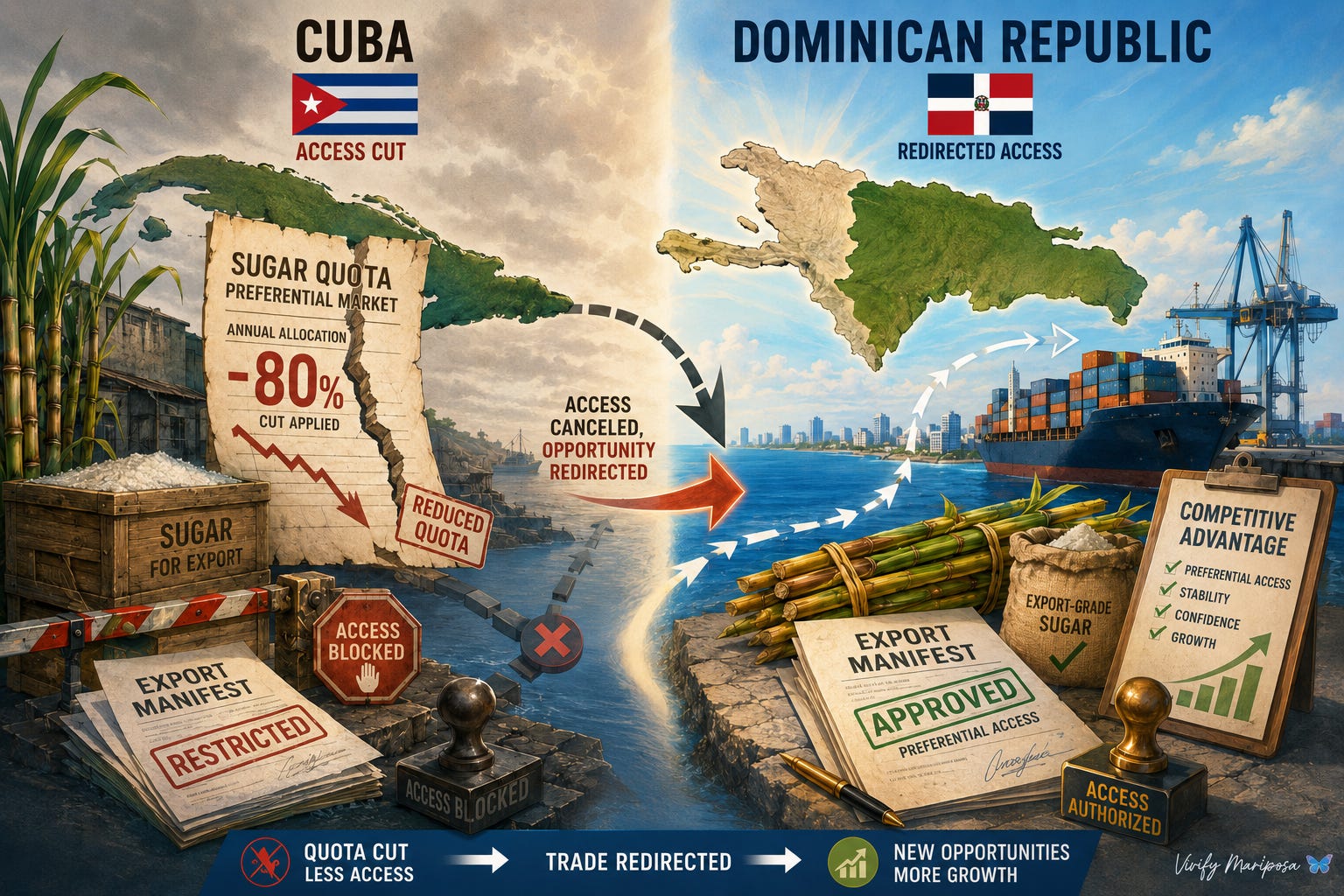
On July 6, 1960, President Eisenhower signed Public Law 86-592, the Sugar Act Amendments. He signed a presidential proclamation the same day. The proclamation left Cuba with only 39,752 short tons for the balance of 1960, compared with an original 1960 Cuban quota of 3,119,655 short tons. Cuba had 744,000 tons of sugar ready for export. In one day that market was effectively closed.
The State Department’s declassified meeting memorandum from that morning, recorded in the Foreign Relations of the United States series Volume VI, 1958 to 1960, Document 544, states that the law, contrary to the recommendations the State Department had made to Congress, forced the United States to buy replacement sugar from the Dominican Republic. The Dominican Republic did not compete for Cuba’s quota through any market mechanism. The law handed it over on the same day Cuba’s was eliminated.
By January 1961 Eisenhower signed a second proclamation fixing the Cuban quota at zero. In his public statement he said Cuba had been committing steadily increasing amounts of its sugar crop to communist countries. That was the justification given to the public. The sequence the documents show is different. The quota was cut in July 1960. Cuba was isolated from its primary export market. The Soviet Union offered to purchase Cuban sugar in February 1960, before the full quota elimination, in a trade agreement signed during Deputy Prime Minister Mikoyan’s visit to Havana. Cuba sold sugar to whoever would buy it after Washington closed the American market. Washington then called the Soviet trade evidence of communist alignment.
The isolation produced the alignment. The alignment was then used to justify the isolation.
Cuba was labeled communist. The Dominican Republic was labeled stable. Balaguer, who had been Trujillo’s puppet and who would use death squads throughout his twelve-year rule, was the stability candidate. The man whose government assassinated hundreds of political opponents received U.S. diplomatic recognition and sugar quota access. The man whose government redistributed agricultural land to domestic farmers received economic punishment. The label did not describe the political systems. It described each government’s relationship to the extraction architecture.
The embargo that followed the quota cut built itself year by year. Cuba was excluded from the Inter-American Development Bank. Cut off from U.S. dollar clearing. Barred from American markets. Isolated from the international financial system every other Caribbean government depended on. The Soviet Union became Cuba’s primary economic partner not because of ideological affinity as the primary driver but because the Soviets were willing to trade after the Americans were not.
Cuba became authoritarian. Political prisoners existed. Speech was controlled. Movement was restricted. These are documented and real. What is equally documented is that every Caribbean government that remained inside the financial system and received American diplomatic support also governed with documented human rights abuses during the same decades. The selective application of the human rights standard was not an oversight. It was a policy.
The poverty that accumulated in Cuba over sixty years of embargo was then presented as proof that communism fails. The presidential proclamations, the congressional legislation, the banking exclusions, the trade barriers, and the deliberate economic isolation that produced that poverty are in the government records. The public explanation erased them. What remained in the public story was the image. Cuba is poor. Cuba is communist. Communism made Cuba poor. Do not become Cuba.
Every Caribbean government that came after 1960 absorbed that lesson through demonstration. Cuba was the permanent warning. Grenada in 1983 was the live confirmation. The machinery did not need to explain itself. It only needed to make the example visible enough that every government in the region understood the cost of stepping outside it.
Now the warning is crumbling from inside.
The Cuban Observatory of Conflicts, which publishes monthly protest tallies from inside Cuba, documented 11,268 protests, complaints, and critical statements against the government of Miguel Díaz-Canel in Cuba during 2025. Its own website confirms 1,333 protests in December alone. The blackouts that began in February 2024 became the most severe living crisis Cuba has experienced since the dissolution of the Soviet Union in 1991. In some parts of Havana, residents endured outages lasting more than 19 hours a day. By May 2026 Cuba had completely run out of fuel. The Cuban population shrank by 10 percent between December 2021 and December 2023, mostly through emigration. The people the machine used as the permanent warning are now rising against the government the machine’s punishment helped create and sustain.
On January 3, 2026, pursuant to a request from the Attorney General, the U.S. Armed Forces conducted targeted and limited military strikes within Venezuela to apprehend and transport Nicolás Maduro and Cilia Flores to the United States for federal criminal prosecution. That is the White House Office of Management and Budget’s own language in its Statement of Administration Policy dated January 8, 2026. Maduro had been sending subsidized oil to Cuba. After his removal that oil stopped. The Trump administration imposed an oil embargo on Cuba. Cuba ran out of fuel. Trump maintained Cuba’s designation as a State Sponsor of Terrorism. On May 7, 2026, the State Department sanctioned the military conglomerate GAESA, which controls much of Cuba’s economy, along with Moa Nickel S.A. and its executive. Secretary of State Marco Rubio then publicly offered $100 million in food and medicine to Cuba, conditioned on distribution being conducted through the Catholic Church and independent humanitarian organizations rather than through GAESA or the Cuban government.
The Cuban government initially denied a formal offer existed. Then it said it was willing to hear the terms.
The offer is not charity. The condition is the point. The $100 million bypasses GAESA precisely because GAESA is the military conglomerate that controls the Cuban economy the way that Central Romana controls Dominican sugar. The offer positions the U.S. as delivering directly to the Cuban people over the head of the structure that extracts from them. Whether Cubans accept that framing or not, the mechanics are familiar. The machine that removed Cuba from the financial architecture in 1960 is now offering re-entry through a humanitarian door conditioned on restructuring who controls the distribution.
The label changed. The question underneath it did not. Who controls the infrastructure. Who controls the distribution. Who profits when the people use it.
1978 to 1986: The Socialist International Implements IMF Austerity
The PRD, affiliated with the Socialist International, governed the Dominican Republic from 1978 to 1986. Antonio Guzman won in 1978 in what was described as the country’s first peaceful transfer of power in the modern era. The PRD drew its support from landless peasants and urban workers. Its founding ideology was center-left social democracy.
Guzman moved cautiously to implement reforms but oligarchic elements remained powerful and the economy was fragile. A hurricane devastated the country in 1979. The faltering economy produced inflation, strikes, and depressed conditions. In 1982 Salvador Jorge Blanco won the presidency with a PRD congressional majority. The party had the presidency and the legislature. By every conventional measure it had the mandate to govern.
In 1983 the Jorge Blanco government began implementing IMF austerity measures. Prices for bread, milk, cooking oil, sugar, and medicine tripled and quadrupled. The government that had campaigned on worker and peasant support was now making those workers and peasants pay more for the basic necessities of life under external financial conditions. Protests broke out in Santo Domingo and across the country. Police and soldiers fired into crowds. More than 100 people were killed. More than 4,000 people were arrested. The government shut down two radio stations and a television station. Police occupied union headquarters to prevent further demonstrations. The government used similar tactics when new austerity measures drove food and fuel prices up another 50 percent in January 1985.
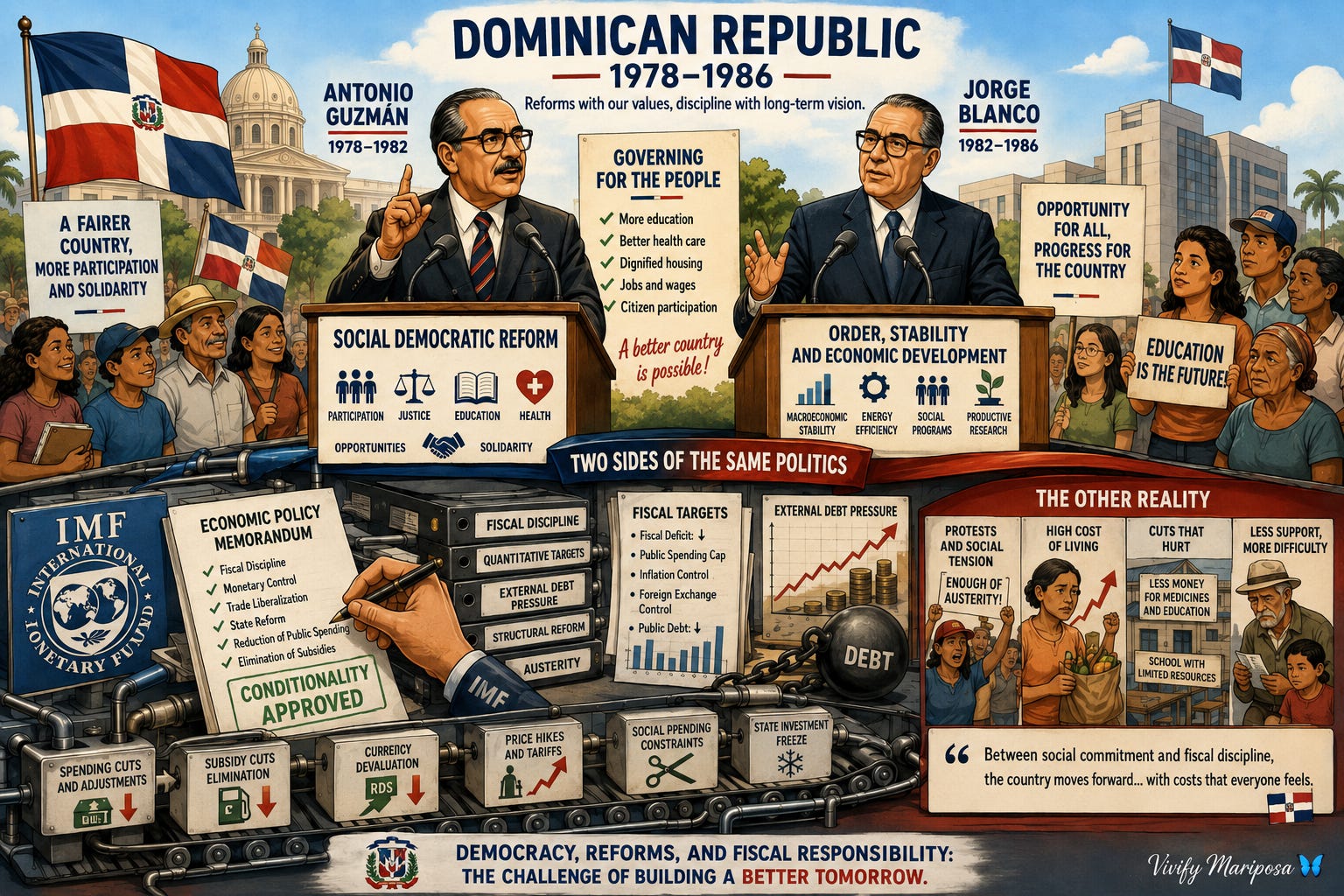
The Socialist International card was in one pocket. The IMF conditions were in the other. The workers who protested received bullets from a government that called itself their representative. Over 2.9 million Dominicans lived below the poverty line in 1984. By 1989 that figure had reached 4.2 million. The IMF program ran. Poverty increased.
The language called it restoring fiscal stability and laying the groundwork for sustainable growth.
Balaguer returned in 1986 under the Partido Reformista Social Cristiano, a party whose name carried social-Christian reform language while its machinery functioned as the conservative anti-communist order. The same bond market access. The same structural dependency on foreign capital. The same corporate ownership of Dominican agricultural and mineral infrastructure. He won again in 1990 in an election the opposition charged was marred by fraud. He won again in 1994 under circumstances serious enough that international pressure forced him to a shortened two-year term. Three elections under documented irregularities. Continuous American recognition throughout.
The party changed. The label changed. The fiscal arrangement did not. The working class paid under both.
1996 to 2020: The Founding Father’s Party and the Creditor Architecture
The PLD was founded by Juan Bosch in 1973. Bosch, the man removed by military coup in 1963 after seven months in office, the man the military accused of being too permissive with communists for refusing to ban a political party, founded a new party after leaving the PRD. His stated model was a reformist anti-clerical party organized around what he called a Leninist party structure. His target constituency was the petit bourgeoisie, the middle class and small business owners he believed were the most politically advanced social class in the Dominican Republic.
In 1996 the PLD came to power by allying with Balaguer. The man Bosch had been exiled from his own country to stop was now the vehicle through which Bosch’s own party won its first election. The alliance was called the Frente Patriotico, the Patriotic Front. Its target was Jose Francisco Peña Gomez, the PRD’s candidate, a Black Dominican of Haitian origin who had been one of the leaders of the 1965 democratic revolt that sought to restore Bosch to the presidency that the military coup had taken from him.
The party Bosch founded did not come from the right. That is what makes the 1996 election so revealing. The PLD won its first presidency by joining Balaguer’s conservative anti-communist machinery to block Peña Gómez, the most credible left-popular candidate the country had produced. The campaign against Peña Gómez included documented racial attacks questioning his loyalty and citizenship because of his Haitian origin. The PLD and Balaguer’s forces ran a coordinated campaign against the Black Dominican candidate and won.
Leonel Fernandez governed from 1996 to 2000 and returned for 2004 to 2012. Danilo Medina governed 2012 to 2020. The PLD held the presidency for most of two decades. During that time the country tapped international bond markets twenty-six times with Citigroup and JPMorgan as the initial purchasers in each issuance. The party founded by a man who was overthrown for being insufficiently hostile to communists signed more bond agreements with Wall Street than any previous Dominican government.
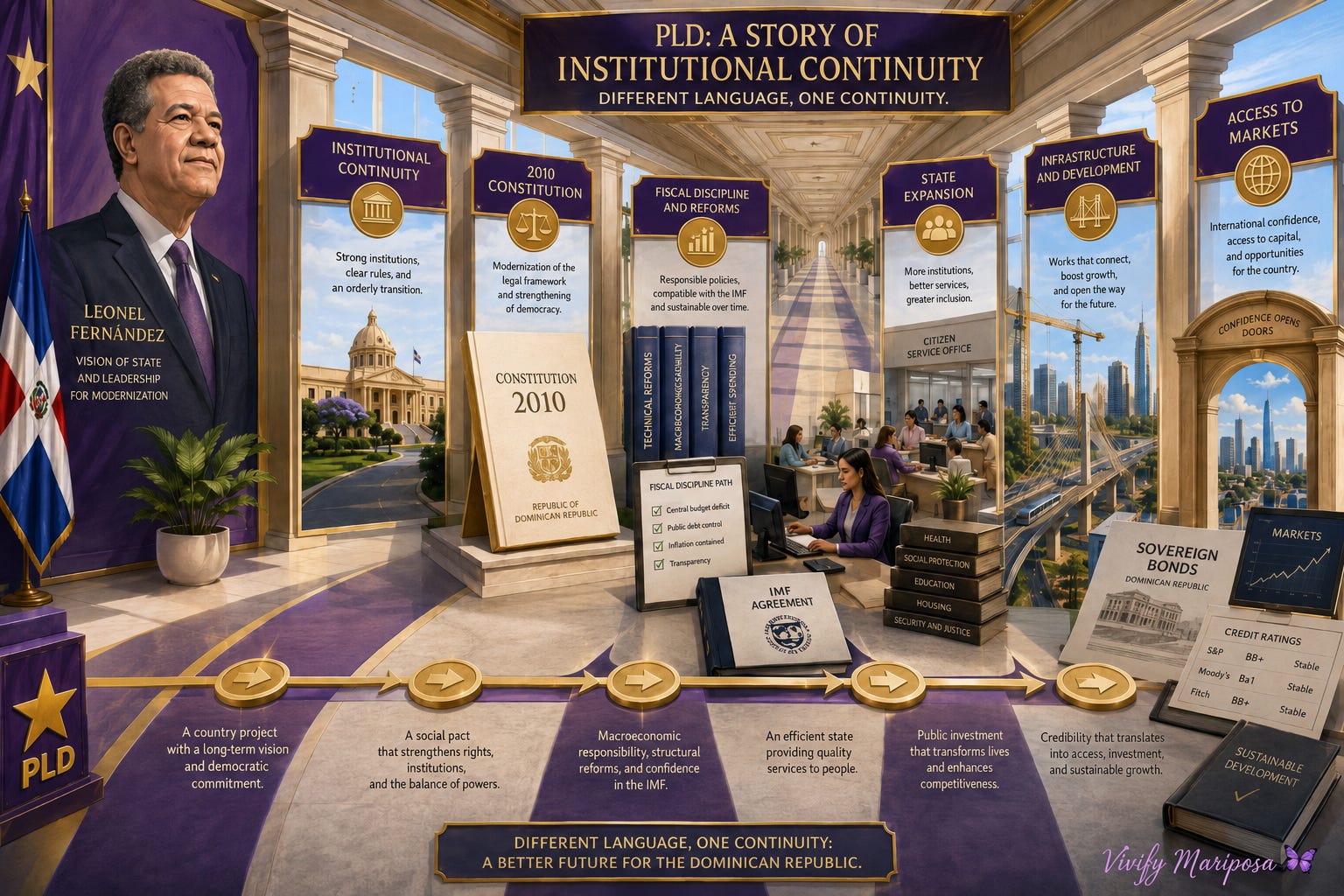
On November 9, 2009, the IMF Executive Board approved a 28-month Stand-By Arrangement for the Dominican Republic. The amount was SDR 1,094.5 million, approximately $1.7 billion, at 500 percent of Dominican quota. The conditions included fiscal consolidation, structural reform, electricity sector reform, subsidy elimination, central bank recapitalization, and inflation targeting. The government committed to eliminating untargeted electricity subsidies, reducing public sector deficits, and adopting full-fledged inflation targeting over the medium term. These commitments were not suggestions. They were performance criteria. Missing them meant losing disbursement access.
On January 26, 2010, sixty-three days after the IMF program was approved, the Dominican Republic proclaimed its 38th constitution. Article 7 established the Dominican Republic as a Social and Democratic State of Law. The full text states that the Dominican Republic is organized in the form of a unitary Republic, founded on the respect for human dignity, the fundamental rights, labor, popular sovereignty, and the separation and independence of the public powers. Article 4 specifies that the government is civilian, republican, democratic, and representative. Article 268 protects that form of government by prohibiting any reform that would change those characteristics.
The effective protection of the rights of the person, the respect for their dignity and obtaining the means that permit their improvement in an equal, equitable, and progressive form, within a framework of individual liberty and social justice, compatible with the public order, the general well-being and the rights of all, is described in the constitution as an essential function of the State.
The state was now constitutionally obligated to guarantee progressive improvement of rights within a social justice framework. The IMF was simultaneously conditioning the state to consolidate its fiscal position, eliminate subsidies, and restrain public spending. The constitutional obligation expanded. The fiscal space contracted. Both arrived in the same three-month window.
Fernandez described the reform in his own published writings as consolidating the democratic and social rule of law and as part of the era of Latin American neo-constitutionalism. He was correct about the lineage. The same wave produced constitutions in Bolivia under Evo Morales, in Ecuador under Rafael Correa, and in Venezuela under Hugo Chavez that expanded state obligations and social rights language while those governments opened their economies to external financial management and debt programs. The language was progressive. The financial architecture was constant.
The first IMF disbursement review under the Stand-By Arrangement was completed on April 8, 2010. Seventy-three days after the constitutional reform was proclaimed. The government received approximately $120 million in IMF money while the constitution it had just inscribed promised more than the conditions governing that money allowed it to deliver.
The Odebrecht corruption scandal emerged under Medina’s government. The Brazilian construction giant admitted in a plea agreement with the U.S. Department of Justice to paying more than $92 million in kickbacks and bribes to Dominican officials and businesspeople to secure construction contracts in the country. The investigation crossed party lines. Officials from multiple political formations received Odebrecht money. The corruption was not a malfunction of the political system. It was the mechanism through which state contracting resources were distributed to political networks regardless of which party held the presidency. The machine does not require honest governments. It requires compliant ones. Corrupt and compliant functions identically.
After the Stand-By Arrangement expired in March 2012, the IMF recommended Post-Program Monitoring. The formal program ended. The surveillance continued. Annual Article IV consultations maintained continuous external assessment of Dominican fiscal behavior. IMF staff visited, assessed, recommended, and published. Rating agencies used those assessments to price Dominican sovereign debt. Non-compliance with IMF recommendations raised borrowing costs without requiring any formal enforcement action. The conditionality became ambient. It did not need a signed agreement to function.
2020: New Party, Same Architecture
The PRM under Luis Abinader took power in 2020. Center-right in the labels applied to it. Business-aligned. Presenting itself as the clean alternative to PLD corruption.
On April 29, 2020, the IMF Executive Board approved emergency financing of approximately $650 million under the Rapid Financing Instrument. The SDR amount was 477.4 million, 100 percent of Dominican quota. The stated purpose was meeting urgent balance of payments needs from the COVID-19 pandemic.
Three days earlier, on April 1, 2020, the World Bank had released $150 million to the Dominican Republic. This money came from a Catastrophe Deferred Drawdown Option established in 2018, two years before the pandemic. The Cat-DDO was established in 2018 as the first of its kind in the Caribbean and had required, as conditions of availability, a series of government reforms to improve institutional and regulatory frameworks for disaster resilience. Those reforms included measures to strengthen the resilience of the health sector in compliance with international regulations mandated by the Pan American Health Organization and the World Health Organization. The emergency money was not clean financing that arrived with no prior conditions. It was drawn from a credit line that had been pre-conditioned in 2018. The conditions were already embedded when COVID provided the trigger to draw on it
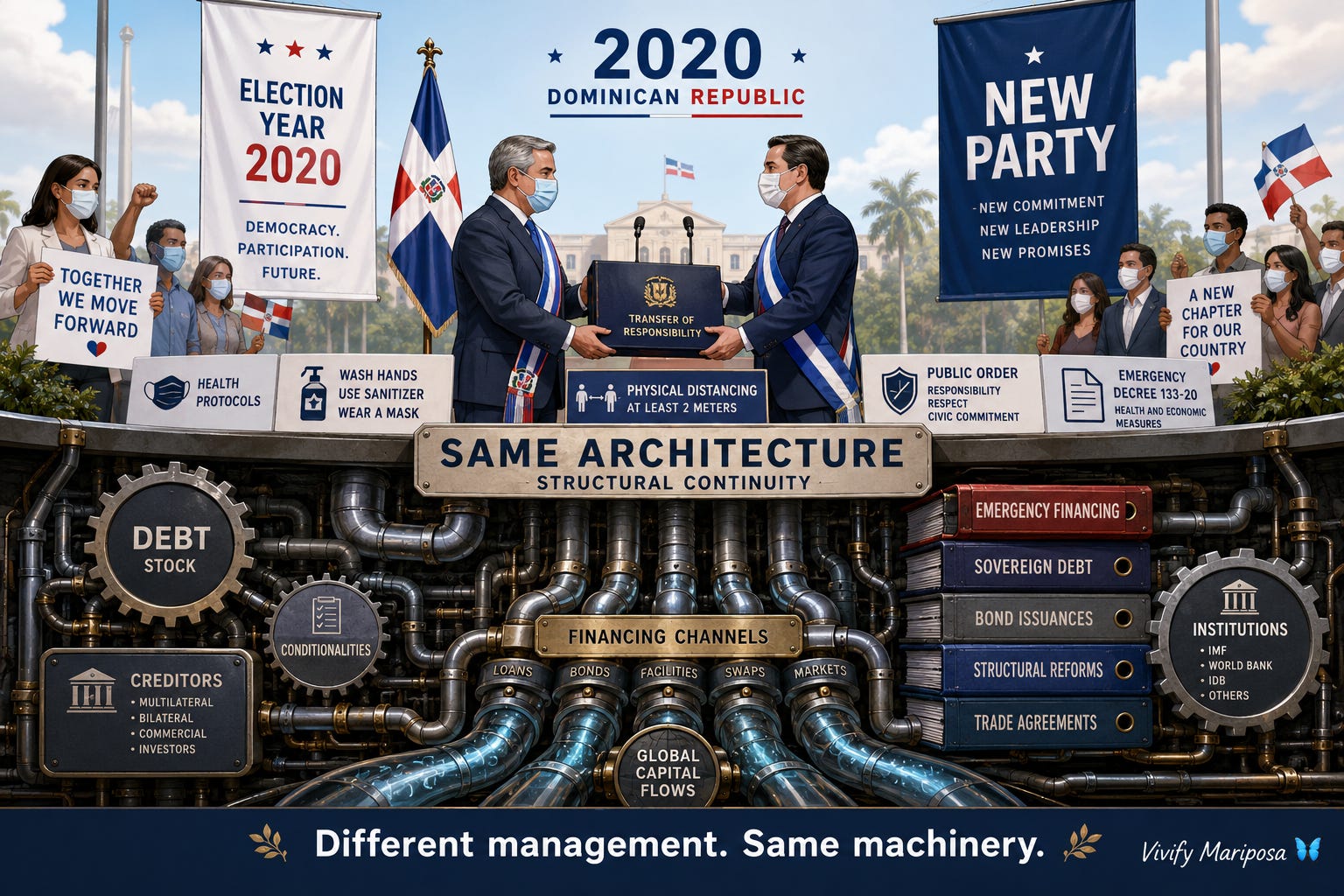
In June 2020 the World Bank approved an additional $100 million COVID-19 response loan. Total World Bank COVID financing reached $250 million. Combined with the IMF RFI, the Dominican Republic received approximately $900 million in emergency financing in 2020 across the two institutions. The IDB and other multilateral sources provided additional support.
New party. New label. New government presenting itself as the reform administration cleaning up PLD corruption. The creditor architecture entered through the same institutional relationships it had always used. The bond payments continued to flow through the same clearing infrastructure. The working class share of national income fell from 12.6 percent in 2019 to 11.4 percent by 2024. The ITBIS regressive consumption tax remained. No government of any label changed it.
The Bond Repayment Path
My friend argued about which party represented the left. The bond repayment path does not have a left lane.
When the Dominican Republic makes sovereign bond payments, the money flows through the Depository Trust Company in New York, Euroclear Bank in Brussels, and Clearstream Banking in Luxembourg. Citigroup Global Markets Inc. and J.P. Morgan Securities LLC have acted as initial purchasers in twenty-eight documented international bond issuances. The law firm Cleary Gottlieb has represented the Dominican sovereign in connection with each offering. Every bond issuance is governed by New York law built on an English common law foundation.
The World Bank’s own documentation names Citibank N.A. London office as the Global Agent for debt securities held through DTC, Euroclear, Clearstream, and other clearing systems. The repayment does not go to the United States as owner. The U.S. dollar clears the transactions. The City of London’s financial infrastructure processes and distributes the result. Euroclear and Clearstream are the settlement infrastructure of European financial markets built on the legal and operational architecture the City of London established.
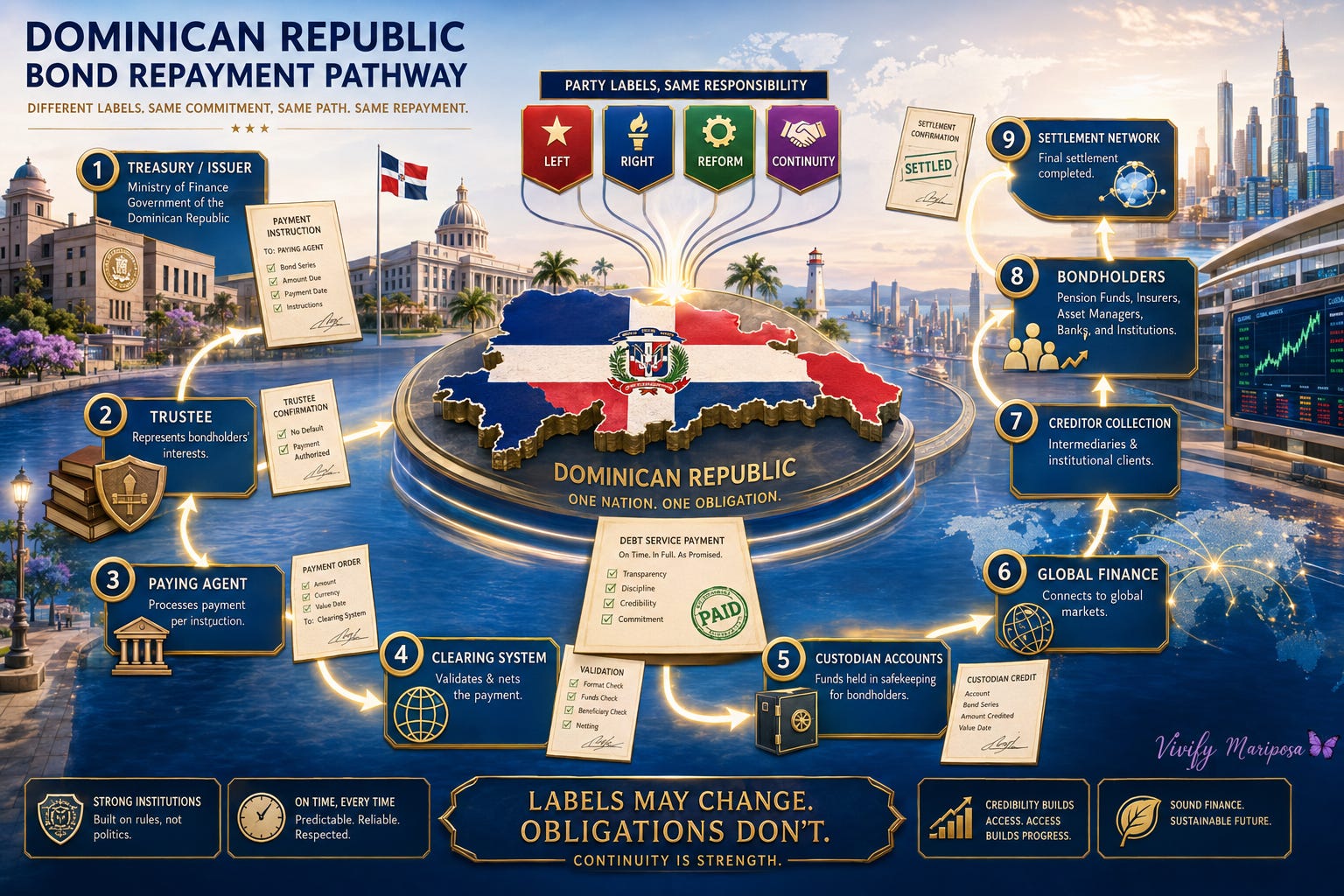
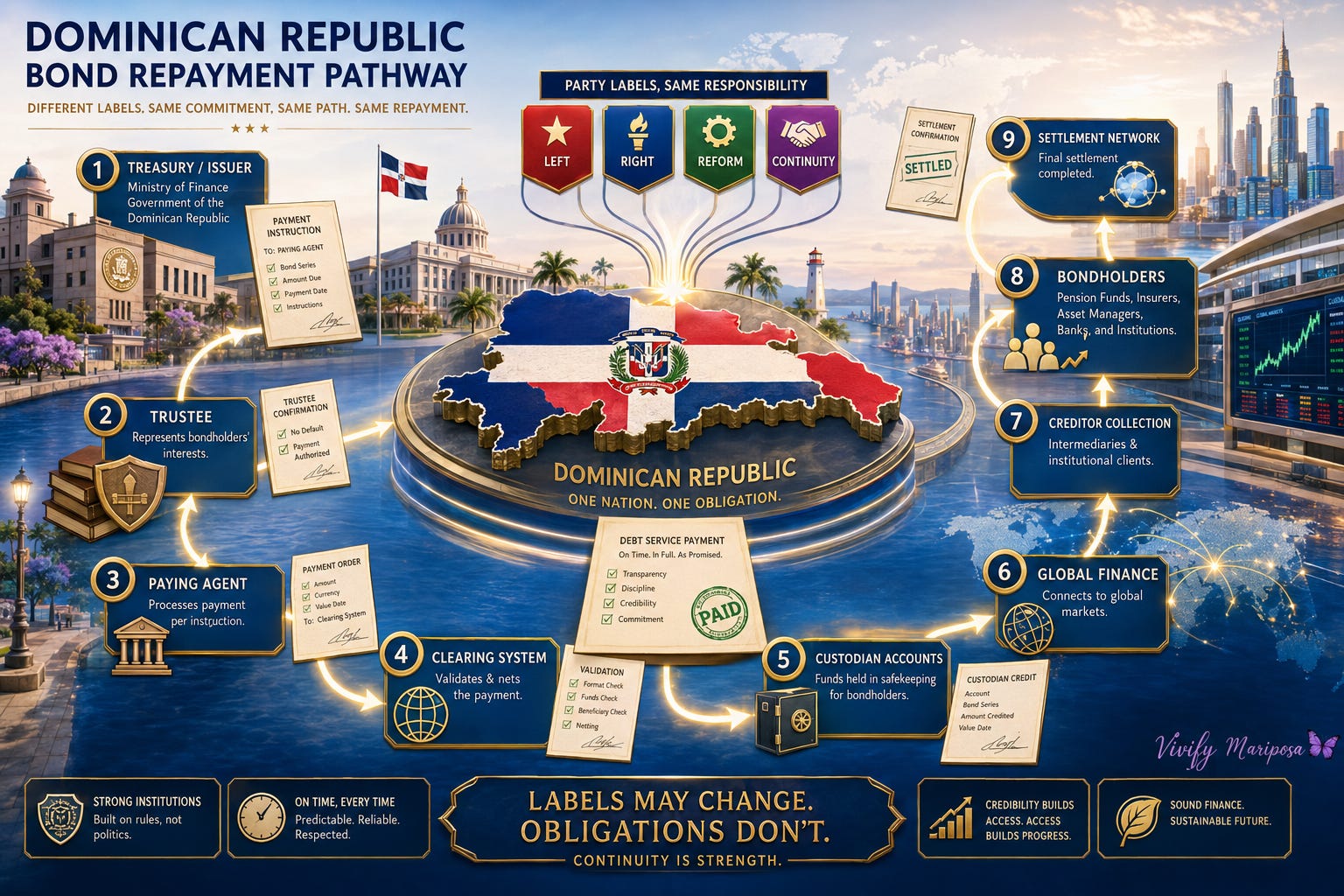
The IMF repayments flow into the SDR-based official reserve system, not to the U.S. Treasury as a direct beneficiary. The World Bank repayments go to instructed payment accounts. The IDB repayments follow parallel multilateral creditor paths. All of it moves through the same global architecture. The City of London is not the only address in that architecture. It is the operational center of it.
The PRD signed some of the indentures. The PLD signed others. The PRM signed the COVID financing documentation. The architecture received the payments regardless of which party produced the signature. The party label tells you what language the government will use to describe the payments. It does not tell you where they go.
The Sugar Infrastructure: 1912 to Now
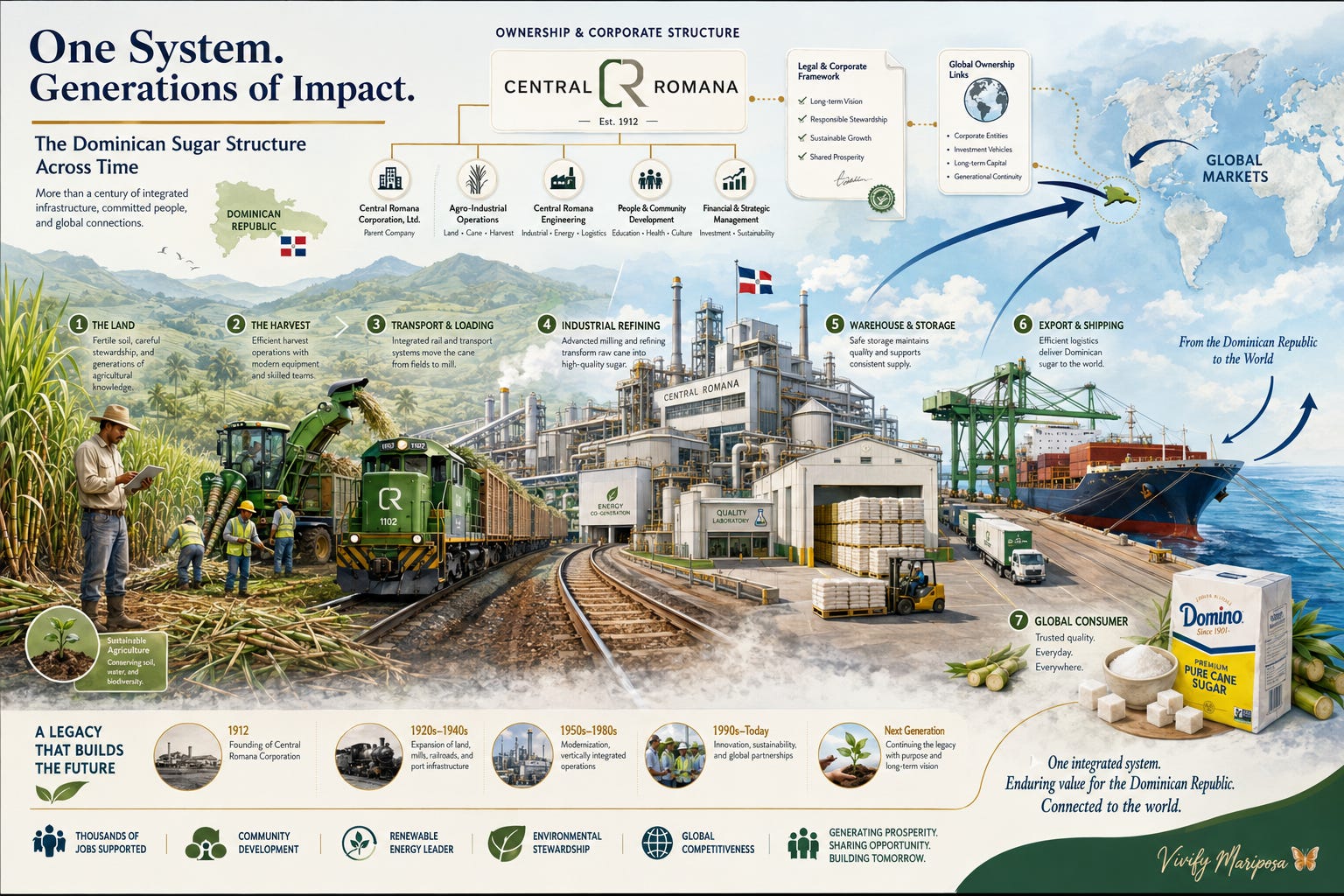
Central Romana Corporation was established in 1912 as a subsidiary of the South Puerto Rico Sugar Company, a multinational corporation incorporated in New York. South Puerto Rico Sugar operated in Puerto Rico from 1901 and in the Dominican Republic from 1910. By the time Bosch was overthrown in 1963, Central Romana had been extracting Dominican sugar through American corporate ownership for over fifty years.
In 1967, Gulf and Western Industries acquired South Puerto Rico Sugar. Central Romana became part of Gulf and Western Americas Corporation, a division of the American conglomerate that was simultaneously building a major presence in Dominican real estate, manufacturing, and tourism alongside its sugar operations.
In October 1984, Gulf and Western sold its sugar operations in Florida and the Dominican Republic to a group of investors. The Fanjul brothers were among the buyers. At the time of the sale, Carlos Morales Troncoso, who would later serve as Dominican Foreign Minister under Leonel Fernandez, was also among the purchasing group. The political and the corporate were connected at the point of acquisition.
The Fanjul family built their original sugar empire in Cuba. Ten mills, three distilleries, real estate across the island. Castro nationalized everything in 1959. The family fled to Florida, raised $640,000 among Cuban exile communities, bought land near Lake Okeechobee, and started production again by 1961. The family that lost its Cuban empire to the revolution that Cuba’s revolution was used to warn the rest of the Caribbean against rebuilt on Florida and Dominican soil what Cuba took from them.
In 1984 they acquired the Gulf and Western Dominican operations. Central Romana. The same infrastructure that had been extracting Dominican sugar since 1912. The same land system. The same labor arrangements. The same export relationships. A different corporate flag.
Fanjul Corp. today holds a 35 percent stake in Central Romana. Central Romana is the largest private employer and landowner in the Dominican Republic. It produces 59 percent of the country’s sugar. It exports approximately 200 million pounds annually to the United States. The Fanjul family controls Domino Sugar, Florida Crystals, C&H Sugar, Redpath Sugar, and American Sugar Refining, which is the largest cane sugar refiner in the world. Florida Crystals alone reported revenues of approximately $5.5 billion in 2024.
Their business was directly aided by the Cuban embargo. The import quota system that punishes Cuba by closing its market access guarantees the Fanjuls an inflated domestic American price by restricting supply. Cuba’s removal from the system in 1960 was structured into the Fanjuls’ ability to rebuild in Florida and the Dominican Republic. The same presidential proclamation that cut Cuba’s quota to zero on July 6, 1960 forced replacement purchases from the Dominican Republic by law. Cuba lost. The Dominican Republic received the access. The Fanjuls eventually acquired the Dominican infrastructure that processed the redirected quota. The sequence is in the documents.
Economists estimate the Fanjul family receives at least $150 million annually in U.S. sugar subsidies. The crop is protected from competition by a quota and tariff system that guarantees an inflated domestic price rather than direct income payments. The government does not write a check. It restricts competition so that the protected producer receives the above-market price from every American consumer who buys sugar.
The family donated an estimated $40 million to both the Republican and Democratic parties between 1990 and 2016. Alfonso Fanjul hosted a fundraiser for Hillary Clinton in 2016. His brother Pepe co-hosted one for Donald Trump the same year. The family gave $1 million to a PAC supporting Trump’s second term and $413,000 to the Republican National Committee. Both parties. Every administration. The subsidy and the quota protection survived every ideological shift because the political investment covered both sides of every election.
In July 2022 the U.S. Department of State placed the Dominican Republic on its Tier 2 watch list in the Trafficking in Persons Report. In September 2022 the U.S. Department of Labor identified Dominican Republic sugarcane on its List of Goods Produced by Child Labor or Forced Labor. On November 23, 2022, U.S. Customs and Border Protection issued a Withhold Release Order against Central Romana Corporation after its investigation found five of the International Labour Organization’s eleven forced labor indicators: abuse of vulnerability, isolation, withholding of wages, abusive working and living conditions, and excessive overtime.
Many of Central Romana’s employees are Haitian migrants. Some were born on Central Romana farms. They live in bateyes, labor settlements on company property. The same population that Haiti’s 1825 independence debt drained for 122 years is cutting Dominican sugarcane under conditions three U.S. government agencies documented as forced labor. The family that lost its Cuban assets to a revolution that was used to warn against the workers taking control of their conditions rebuilt its operation on labor from the country that was punished most severely for declaring that workers were free.
The Withhold Release Order ran from November 2022 through March 2025. The Trump administration quietly lifted it. CBP listed the order as inactive. Labor rights groups confirmed no significant improvement in working conditions preceded the change. Central Romana stated the company was pleased the administration had reviewed the evidence and found no basis to continue the order. The Fanjul Corporation had given $1 million to a PAC supporting Trump before the reversal.
Three U.S. government agencies documented forced labor. A political donation later the documentation was listed as inactive. The sugar kept moving north under the Domino brand in the yellow box with the red logo.
A Dominican sugarcane worker living on Central Romana property does not live differently because the government that allowed those conditions was led by the PRD, the PLD, or the PRM. The party label on the government that signed the bond indenture does not change the conditions in the batey. The constitutional language promising social justice and general well-being sits in Article 7. The forced labor conditions sit in the CBP Withhold Release Order. Both are real. Both are in official documents. Only one describes what the working class actually lives.
Haiti: The Republic That Paid for Its Own Freedom
Haiti freed itself from slavery in 1804. It was the first Black republic in history. The only successful slave revolution in the Atlantic world. The achievement disrupted the logic of the entire plantation economy. It proved that the people doing the labor could take back control of the production. That was the threat. Not the political ideology. The demonstration that the system could be broken from below.
France’s response was not another military campaign. The army had failed. France sent a bill instead.
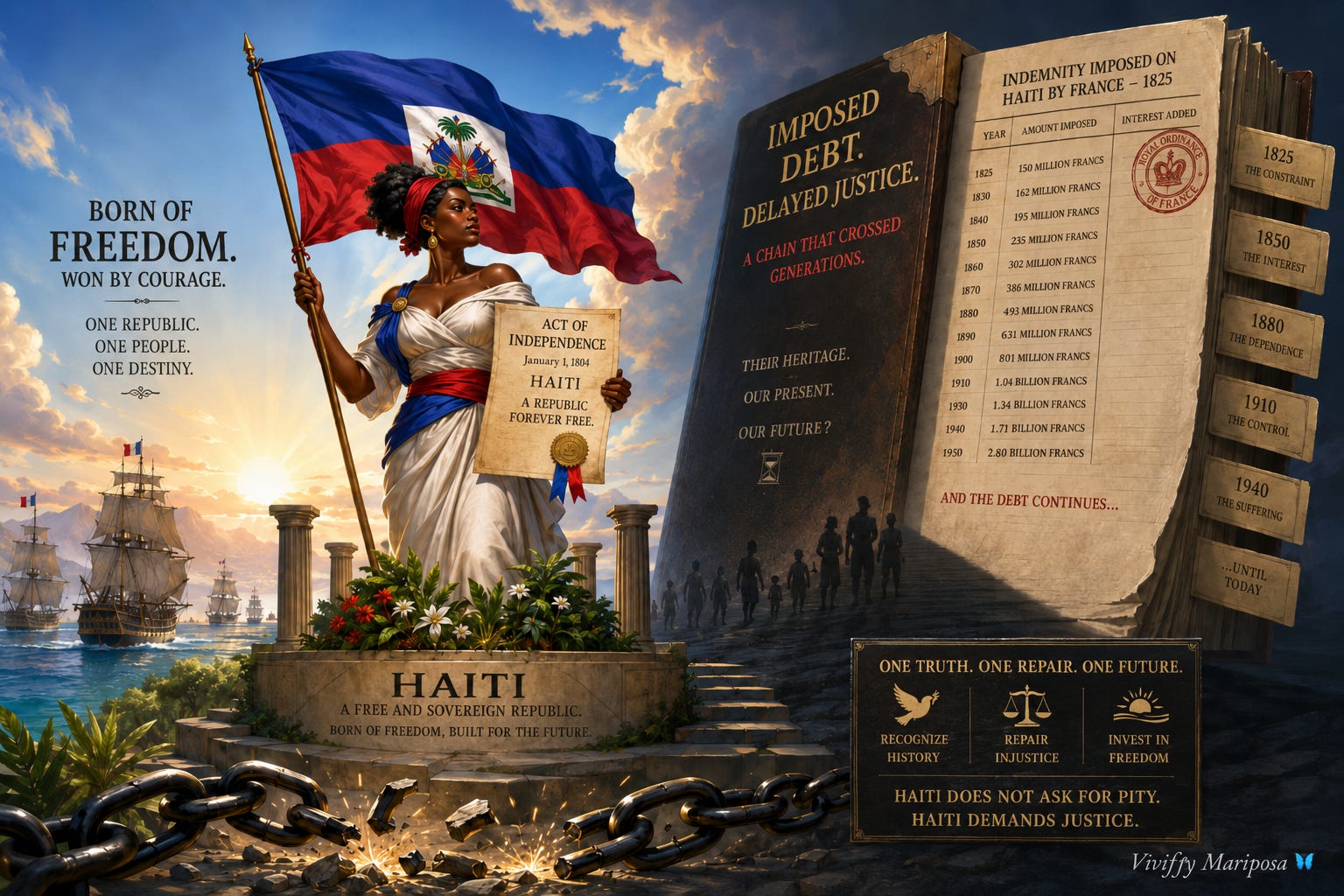
In 1825, besieged by French warships, Haiti’s President Jean-Pierre Boyer agreed to pay an indemnity of 150 million gold francs to France. The payment compensated French plantation owners for the property they lost when Haitians freed themselves. The property was the Haitians themselves. Haiti’s annual state revenue in 1825 was approximately 10 million francs. The indemnity was fifteen years of total government revenue. The first payment of 30 million was due by December of that same year.
Haiti borrowed immediately. The first loan, known as the Lafitte Loan named after banker Jacques Laffitte, totaled 30 million francs. After commissions, issuance fees, and interest rates, Haiti received far less than the face value and began paying interest on a debt it had borrowed to pay an indemnity it had agreed to under military threat. The debt structure was designed to be impossible. The indemnity was deliberately disconnected from Haiti’s economic reality. France had calculated based on the Code Noir that enslaved laborers on an estate constituted 30 to 60 percent of the property value. Haiti was paying for the market value of itself.
In 1838 France agreed to reduce the remaining debt to 60 million gold francs to be paid over 30 years. The final payment on that reduced debt was made in 1883. But the loans Haiti had taken to service the original debt carried their own interest obligations. The last payment connected to the entire debt structure was not made until 1947. One hundred and twenty-two years after the indemnity was imposed.
By 1914 more than three quarters of Haiti’s national budget was being drained to service the debt to French banks. Schools, hospitals, roads, agricultural development, infrastructure, institutions. All of it subordinated to creditor payment. Had that money been retained and invested domestically, economists estimate it could have added more than $20 billion to Haiti’s economy over time. That $20 billion is the Haiti that does not exist because the money went to Paris.
The United States occupied Haiti from 1915 to 1934. The stated purpose was restoring order after political instability. The operational reality was controlling a country that owed money to creditors and whose debt management had become a matter of American financial interest. The occupation reorganized Haitian customs collection, restructured the debt, and established institutional arrangements that prioritized creditor access to Haitian fiscal resources.
The international institutions came after the occupation with different instruments but the same directional logic. Aid programs created dependency rather than capacity. Bilateral and multilateral assistance came with governance conditions that shaped Haitian fiscal behavior toward creditor compatibility. After the 2010 earthquake, the international response included the Interim Haiti Recovery Commission co-chaired by Bill Clinton. The commission had more foreign voting members than Haitian ones. A republic that had been independent since 1804 was effectively governed after its worst natural disaster by an international body with no electoral mandate from any Haitian citizen.
Today armed gangs control approximately 85 percent of Port-au-Prince. Haiti is the poorest country in Latin America and the Caribbean. The public explanation in international media and institutional reports is governance failure, political instability, and corruption. The documents show a country that paid for its own freedom for 122 years, experienced U.S. military occupation for 19 years, was managed through aid dependency and institutional control for two centuries afterward, and now experiences the structural collapse of a society that was systematically prevented from retaining the resources it would have needed to build what the public explanation says it failed to build.
The communist label was never required. The debt did the same work over a longer timeline.
And when the debt architecture needed a modern enforcement moment, it did not use debt. It used a different method.
President Jovenel Moïse refused the AstraZeneca vaccine shipment. Haiti recorded 482 COVID deaths despite population density comparable to New Jersey, which recorded 26,509. Moïse did not align with the institutional pandemic framework that arrived with the emergency financing packages. On July 7, 2021, he was shot 12 times by a foreign hit squad at his private residence in Port-au-Prince. The Biden administration offered vaccines to Haiti almost immediately after he was removed. The replacement government complied. The vaccines arrived.
The sequence is: refuse the institutional framework, get removed, replacement complies, the program resumes.
Haiti in 2021 is the same sequence as the Dominican Republic in 1963. Different decade. Different mechanism. Different language. The result was identical. The government that did not comply was gone. The government that replaced it did.
Jamaica: The Forty-Year Cycle
Jamaica gained independence from Britain in 1962. Barclays Bank had been operating in Jamaica since 1837 under its predecessor name the Colonial Bank. When Barclays acquired the Colonial Bank in 1925 and renamed it Barclays Bank Dominion Colonial and Overseas, the continuity of the financial infrastructure through the political transition of Jamaican independence was already assured. The flag changed. The accounts still cleared through London.
By the late 1970s Jamaica needed IMF financing. The Manley government, left-leaning by Caribbean standards, had attempted social programs and alignment with the Non-Aligned Movement that created friction with Washington and financial markets. When balance of payments problems emerged, the IMF arrived with its standard package. Open the markets. Restrain public spending. Devalue the currency. Remove capital controls.
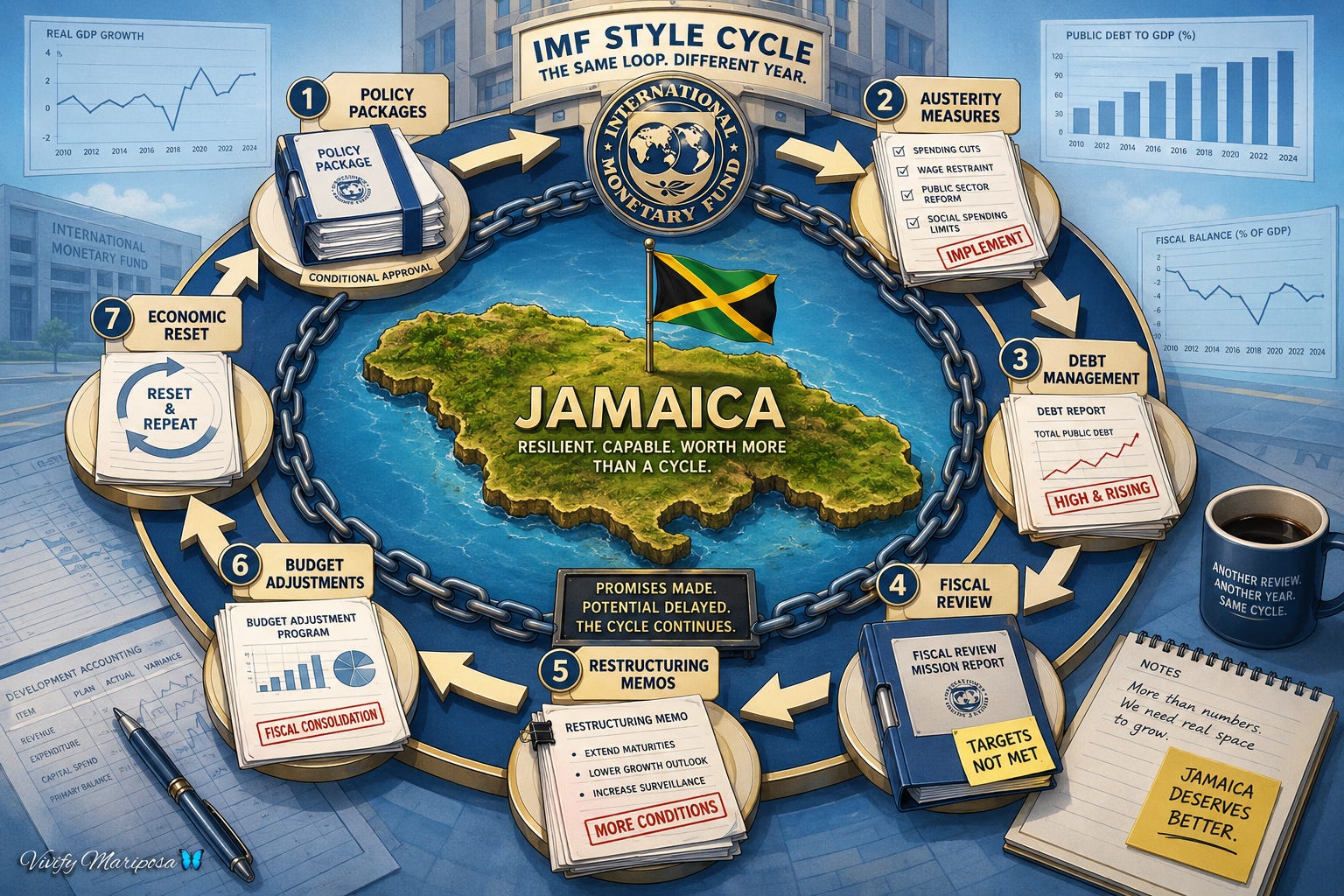
The conditions produced the standard outcomes. Prices rose. Services contracted. The government that had campaigned on social programs was implementing their opposite under external financial conditions. The party changed at the next election. The new government inherited the debt and the surveillance. Jamaica celebrated the end of IMF borrowing in the mid-1990s. It returned in 2010. The same institution. The same conditions. The party in office when Jamaica returned to the IMF in 2010 was different from the party in office when it celebrated leaving in the 1990s. The IMF relationship was unaffected by the electoral change.
Harvard Business School documented the self-reinforcing cycle in a published case study. High public debt. Sluggish private sector. Inefficient public sector. Poverty and crime that do not respond to changes in which party holds office. Forty-plus years of IMF programs. The working class of Jamaica has experienced the conditions that the program conditions produce across every government that managed those conditions.
Grenada: When the Warning Was Demonstrated Live
Maurice Bishop’s New Jewel Movement took power in Grenada in 1979 through a coup and established a government with socialist orientation that received Cuban and Soviet support. Bishop implemented literacy programs, land reform, and infrastructure projects. He described his government as non-aligned and sought development assistance from multiple sources including the European Community and Canada alongside Cuba and the Soviet Union.
In October 1983 Bishop was placed under house arrest by a faction of his own party led by Deputy Prime Minister Bernard Coard. He was released by supporters, taken to Fort Rupert, and executed by firing squad along with several cabinet members on October 19, 1983. The internal conflict within the New Jewel Movement produced a Revolutionary Military Council that took power.
Four days later, on October 25, 1983, the United States invaded Grenada with approximately 7,000 troops under Operation Urgent Fury. The official justification was protecting approximately 1,000 American medical students at St. George’s University. The strategic context was a Cuban-aligned government, a Cuban-assisted airport construction project the Reagan administration had described as a military threat, and the Reagan doctrine of rolling back Soviet and Cuban influence in the Western Hemisphere.
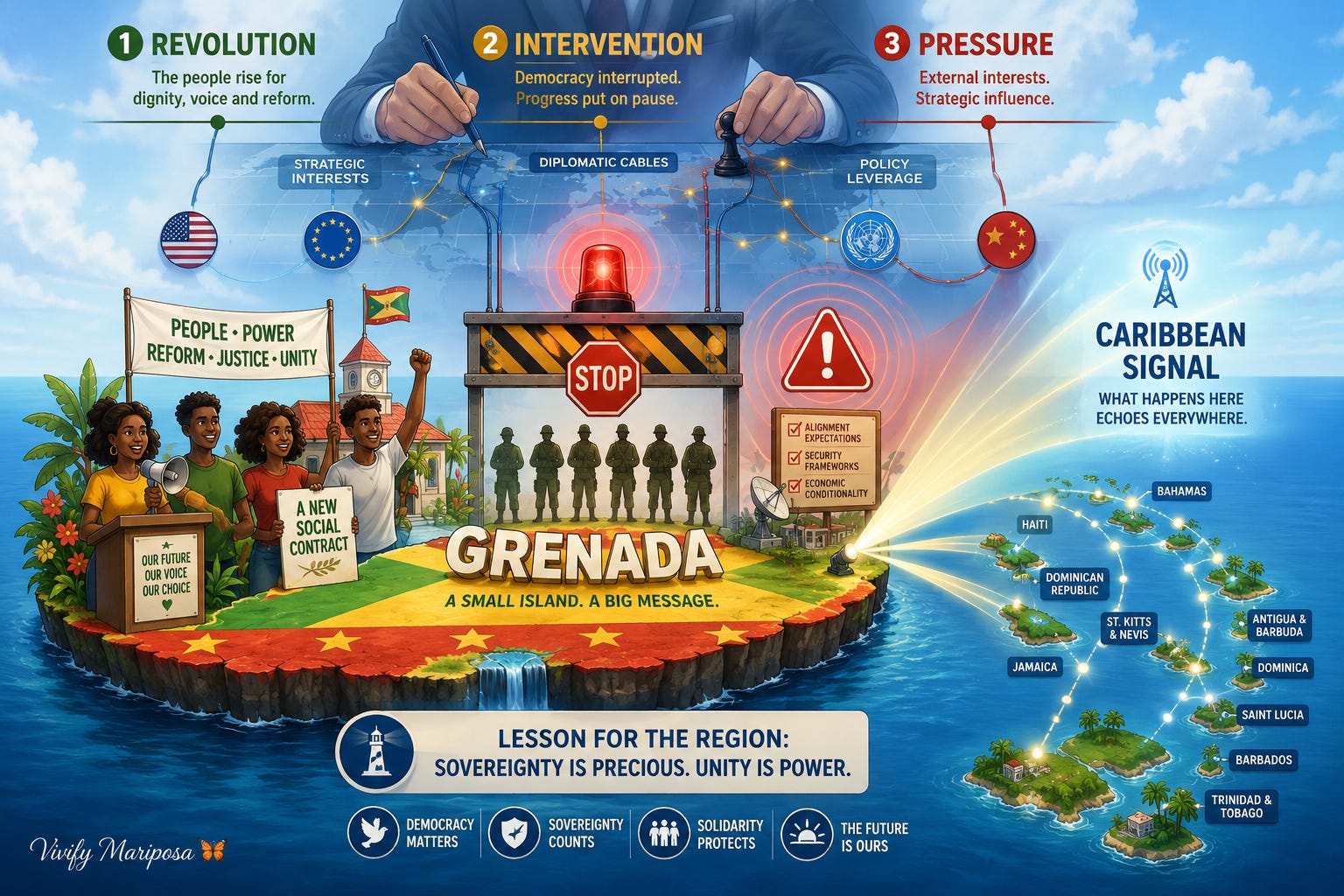
The invasion removed the Revolutionary Military Council. It also ended any possibility of a Bishop restoration or a continuation of the New Jewel Movement’s social programs. Grenada moved into elections and a parliamentary government aligned with the financial architecture. The IMF and World Bank frameworks arrived. The language returned to democracy and development.
The rest of the Caribbean watched. Grenada confirmed what Cuba had established. The price of stepping outside the financial system was not abstract. It was 7,000 troops or sixty years of embargo. Every government in the region made its calculations accordingly.
Puerto Rico: When the Constitution Serves the Creditor
Spain ceded Puerto Rico to the United States in 1898. Puerto Rico has been an American territory ever since. Its population holds U.S. citizenship. They cannot vote for the President. They are represented in Congress by a non-voting delegate. The laws that govern their lives, including the laws that govern their debt, are made by a Congress in which they have no voting representation.
The Jones Act of 1920 required all goods shipped between U.S. ports, including from the mainland to Puerto Rico, to travel on U.S.-flagged ships built in American shipyards and crewed by American citizens. Every import arriving in Puerto Rico was made more expensive than it would be for any independent Caribbean nation that could contract global shipping. This was not presented as a cost imposition. It was presented as part of the territorial relationship and as supporting American shipbuilding and maritime industries. Puerto Ricans paid the cost. American shipping interests received the benefit.
The Puerto Rican constitution contains a provision that prioritizes debt payment above all other expenditures. Interest on public debt must be paid before schools, hospitals, roads, or any other public service receives funding. Creditor priority is written into the foundational law. This provision was not controversial when it was written. It was understood as a signal of fiscal responsibility that would make Puerto Rican bonds attractive to investors. It functioned exactly as designed. Puerto Rican bonds became triple tax-exempt and attracted Wall Street underwriters, hedge funds, and vulture funds hunting distressed economies.
Congress amended Chapter 9 of the federal bankruptcy code in 1984 to specifically exclude Puerto Rico from filing for debt relief. Every U.S. municipality and territory except Puerto Rico could use bankruptcy protection to restructure unmanageable debt. Puerto Rico could not. When the economy declined and the government could no longer service its debt, it had no legal mechanism for restructuring and a constitutional mandate to pay creditors before citizens. The bondholders were, as far as investors were concerned, virtually guaranteed payment regardless of what happened to the underlying economy.
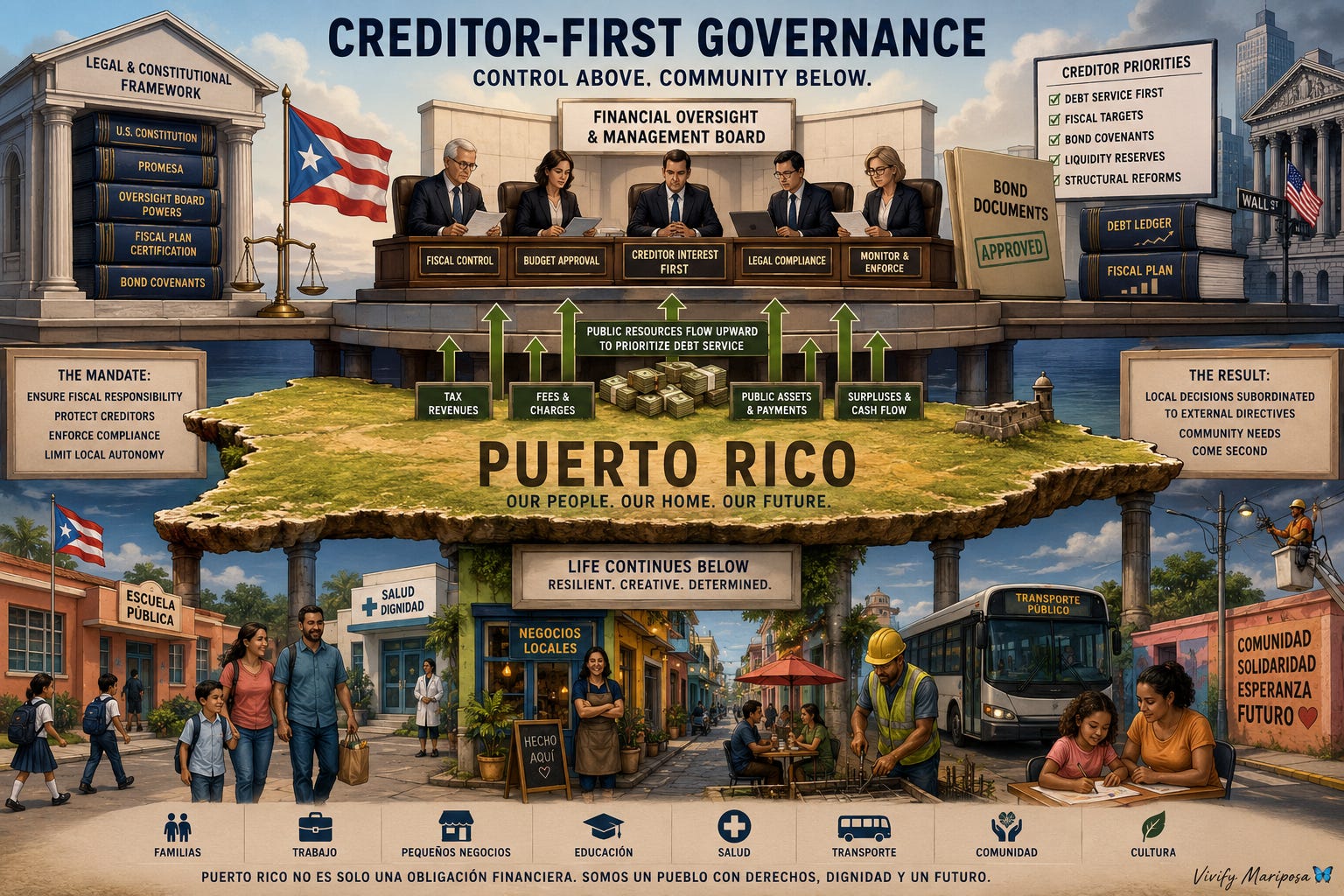
The PROMESA Act of 2016 established a Financial Oversight and Management Board with authority over Puerto Rican fiscal decisions. Board members were appointed by Congress. A territory whose population cannot vote for the Congress that governs it had its fiscal decisions transferred to a body appointed by that Congress when the debt the Congress’s own laws had made impossible to restructure became unserviceable.
The language called it oversight and fiscal management. The population experienced external administration of their economy by creditors their constitution required them to pay first, enforced by a board appointed by a Congress they could not vote for.
Trinidad, Barbados, the Bahamas, Guyana, and the Smaller Islands
The machine does not apply the same method to every territory. It applies the method that matches the specific vulnerability of each. The direction of the wealth is constant. The entry point varies.
Trinidad and Tobago has oil and natural gas. The IMF and World Bank maintain their relationships through surveillance and technical assistance rather than conditionality programs. The language of fiscal sustainability functions as the framework. When energy prices fall, the institutional relationships that were monitoring from a distance move closer.
Barbados entered an IMF Extended Arrangement in 2018 with fiscal consolidation, public sector wage restraint, and structural reform conditions. The language around Barbados in IMF communications is more respectful than the language around Haiti or Jamaica. The machine calibrates its public language to the governance performance of the country it is managing. The conditions travel regardless of how the language is adjusted.
Guyana discovered significant offshore oil in 2015. The World Bank and IDB moved quickly into Guyana’s development planning with the language of resource governance, transparency, and institutional capacity building. The relationships established while the oil starts flowing determine the framework within which Guyana manages its revenues. The language calls it technical assistance. The function is positioning.
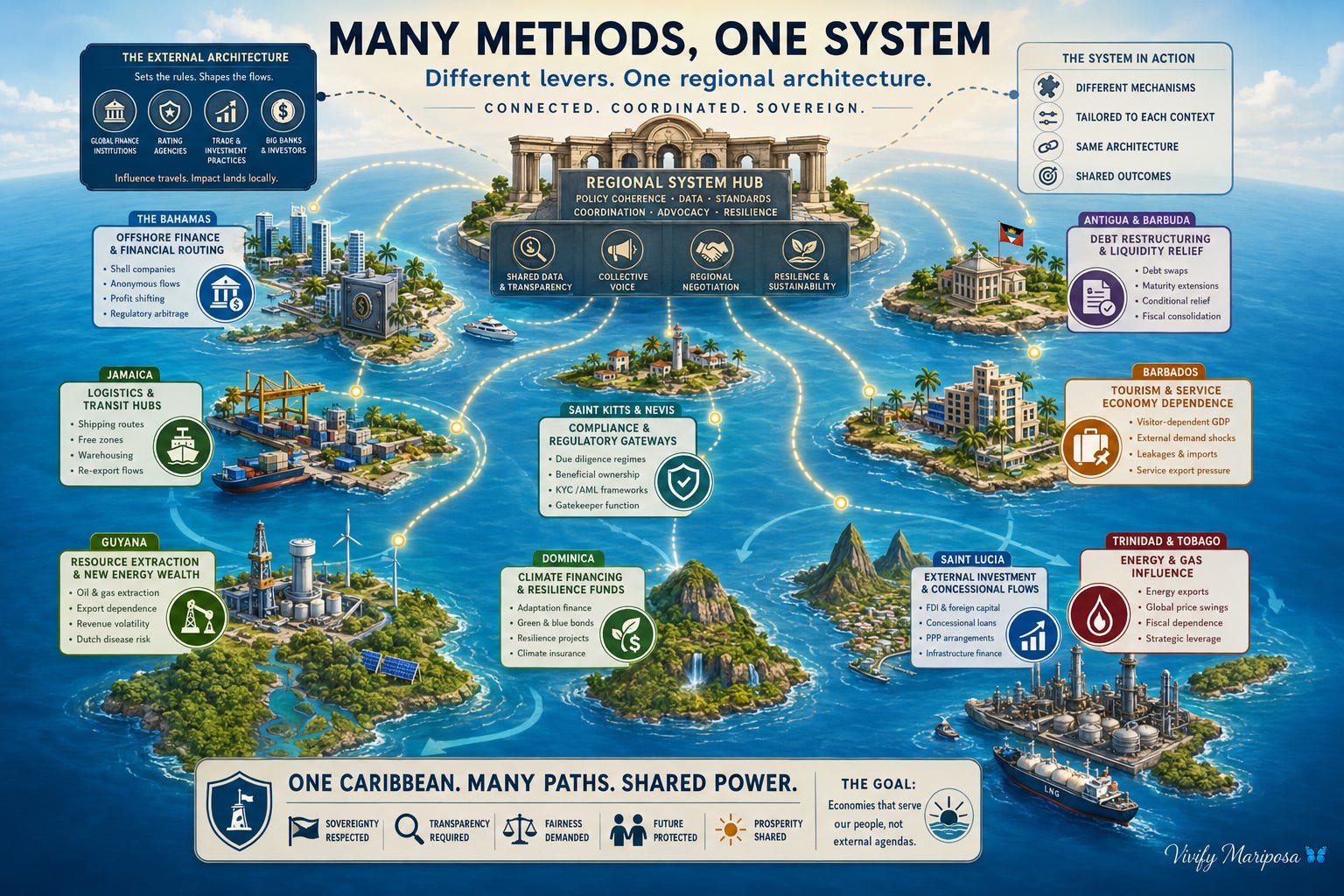
The Bahamas and the smaller Eastern Caribbean islands face tourism dependency that makes their economies structurally exposed to shocks they cannot control. Climate financing has become the entry mechanism. After climate events, reconstruction financing arrives through multilateral channels with institutional conditions attached. The IMF’s Resilience and Sustainability Facility ties climate adaptation financing to IMF engagement and structural reform commitments. Climate catastrophe becomes the entry point for the same institutional surveillance that in other contexts arrives through fiscal crisis. The entry point changes with the vulnerability. The architecture is constant.
What the Language Did to the People Who Use It
The machine’s most durable achievement in the Caribbean is not the debt. Debt can theoretically be restructured. The machine’s most durable achievement is the replacement of the vocabulary through which people think about their situation.
When republic was replaced by social democratic state in the Dominican Republic’s 2010 constitution, the population received a document that promised more from the government. Social justice. Progressive realization of rights. General well-being as an essential state function. These promises sound like progress. What they actually do is make the population dependent on the state’s delivery of what it has promised. And when the IMF conditions restrict what the state can spend, the population experiences the gap not as evidence of the financial architecture’s control but as evidence of political failure. The party changes. The architecture stays. The gap is reproduced under the new party. The population demands another change. The cycle runs indefinitely.
Every Dominican generation since the 2010 reform has had its political discourse structured around which party will deliver on Article 7. Not around who owns the land. Not around where the bond payments go. Not around what the IMF conditions require. Around which party will fill the gap between the constitutional promise and the fiscal reality that the financial architecture makes permanent.
Left in Caribbean political discourse no longer means workers controlling their labor conditions, their productive infrastructure, or their export revenue. Left means a party that uses social language, expands state programs, and creates dependency on a state apparatus that the creditor architecture manages. The social democratic constitutions produced by the neo-constitutionalism wave across Latin America and the Caribbean created exactly this structure. Progressive language. Expanding state obligations. External financial management of the fiscal space within which those obligations operate.
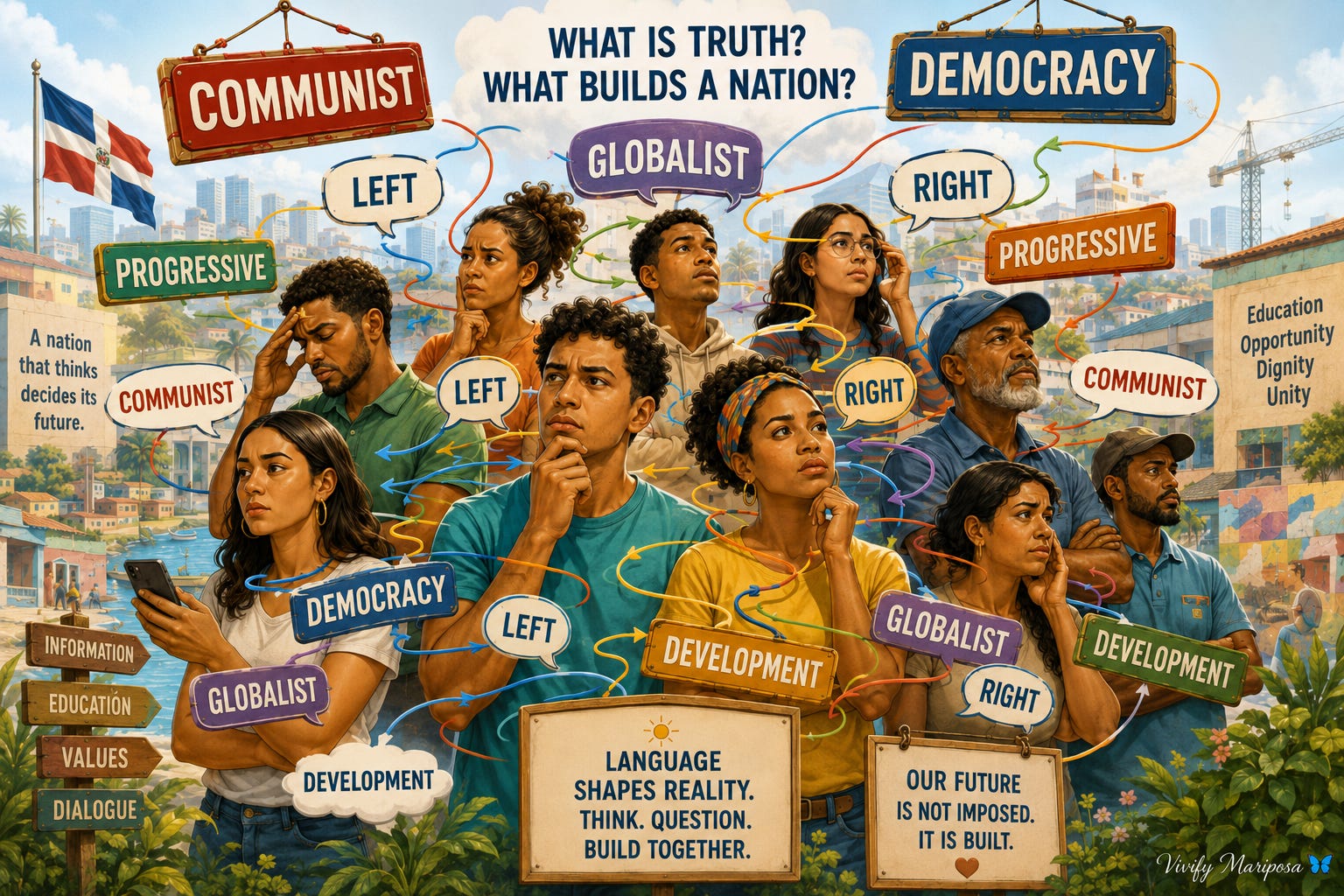
Right no longer means limited government, individual sovereignty, and freedom from state interference. Right means a party that uses conservative language, emphasizes fiscal discipline, and presents IMF compliance as responsible governance while maintaining the same bond market access and corporate infrastructure ownership as the left. The Dominican PRSC under Balaguer governed with death squads. The PRD governed with IMF austerity that killed protesters. The PLD governed with neo-constitutionalist language and stood by the same bond repayment path. The PRM governs with anti-corruption rhetoric and the same creditor relationships. None of these parties represents a genuine alternative to the financial architecture. They represent different styles of managing it.
Communism became the vocabulary that ended analysis. Question the IMF program and you are told you want Cuba. Examine who owns Central Romana and you are told you want nationalization. Ask where the bond payments go and you are told you are against foreign investment. The communist accusation functions as a border on thought. Approach it and the audience trained to use it as a signal stops listening to the argument and starts applying the label. The machine built a vocabulary that makes it almost impossible to describe what the machine is doing without triggering the label it designed to shut down the description.
My friend was not wrong about Dominican political history in any factual sense. The PRD did govern. The PLD did govern. The PRSC did govern. Elections were held. Parties won and lost. All of that is true. What he could not see using the vocabulary he had was that every government that governed used the same financial infrastructure, signed agreements with the same institutions, made payments through the same clearing systems, and left the working class with a smaller share of national income than it had when the government started. The sequence is in the documents. The documents are in the government records. The government records are not the history that was taught.
The One Thing the IMF Could Not Control
There is one thing the IMF could not control. Dominicans.
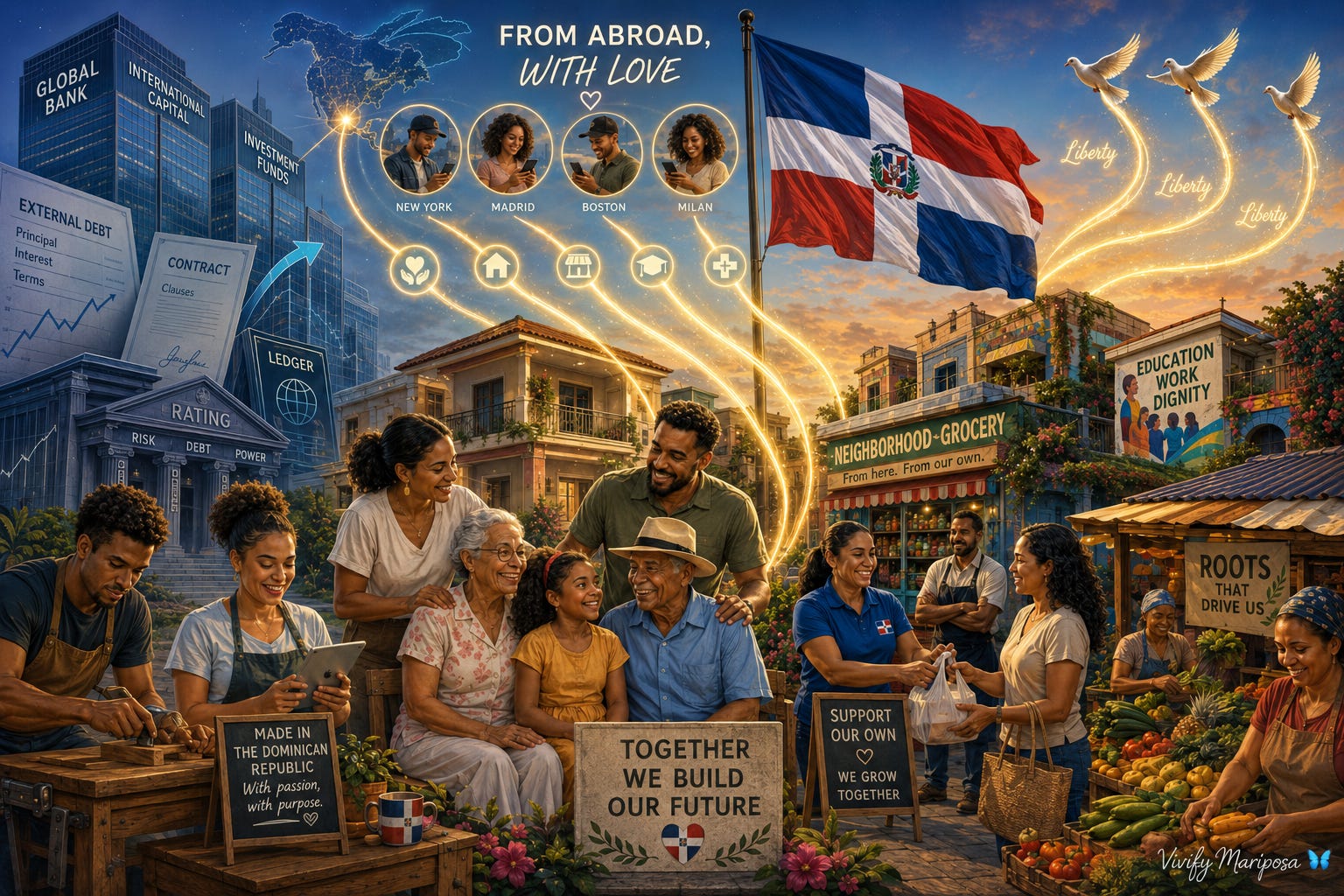
The Dominican Republic is not rising in the Caribbean because the IMF saved it. It is rising because Dominicans keep it alive through work, remittances, sacrifice, family networks, business building, diaspora money, and love of country. Dominican remittances reached more than $11.8 billion in 2025 and continued strongly into 2026. That number is not in the IMF press releases. It is not a condition attached to any Stand-By Arrangement. No party voted for it. No constitutional article created it. Dominicans built it themselves, one wire transfer at a time, from New York, Boston, Miami, Madrid, Santiago, and every city where Dominican hands work and Dominican families send money home.
That $11.8 billion does not flow through Euroclear. It does not go through a paying agent in London. It goes directly into Dominican households. It pays rent. It builds houses. It buys medicine. It keeps families fed when the government’s constitutional promises run into the IMF’s fiscal limits. The remittance is the unofficial national rescue system that no creditor architecture designed and no political party can claim credit for.
The COVID lockdowns showed what democratic-state language looks like when the machine decides it needs to manage bodies. On April 29, 2020, the IMF approved $650 million in emergency financing for the Dominican Republic under the Rapid Financing Instrument. The money arrived. The protocols followed. Curfews. Police checkpoints. Movement restrictions. The language was health and safety. The result was behavioral compliance moving through the same emergency architecture that delivered the financing. Countries that accepted the financing implemented the protocols. The Dominican Republic accepted both.
Dominicans answered through culture.
The word teteo captured it. Gatherings. Music. Street life. Resistance to protocols that treated Dominican spirit like a public-order problem. In neighborhoods across the country people found ways to be together, to play music, to maintain the social fabric that no curfew could fully dissolve. Trucks blocked neighborhood entrances. Communities organized their own perimeters because they did not trust the state’s perimeter to protect their way of life.
I was there. I traveled to the Dominican Republic in October 2020, my birthday. The curfew ran from 3pm to 7am. At certain points the government extended it from 12pm to 5am the next day. The virus did not operate on that schedule. The curfew did. Dominican citizens needed to be inside. My blue American passport gave me movement they did not have. Nobody needed to explain the hierarchy. You could see it in the street.
The resorts were open. The country clubs were operating. The colmadones were closed or restricted. The curfew hours that kept working-class Dominicans off the street did not apply equally to the tourist zones where foreign money moved freely. The rules land on the people who cannot afford the exception. Many Dominicans refused to follow them. That refusal was not ignorance. It was recognition.
The police enforcement in neighborhoods was experienced as control, not protection. Faride Raful publicly warned colmado owners and citizens about complying with established hours under public safety and community tranquility language. The colmadón became a public safety threat. A barrio gathering became a disorder problem. A country club event remained culture. The language of public order is applied selectively to the spaces where the people who are not protected by that language actually live. The spaces where Dominican freedom is most visible, loudest, and least controllable are the spaces that attract regulatory language. That is not about noise. It is about control.
Dominicans still sing libertad, libertad, libertad in the national anthem. The anthem is not ironic. It is a statement of what Dominicans understand themselves to be regardless of what the constitutional text says or what the IMF conditions require or what the curfew schedule permits.
The IMF can manage debt. The parties can manage ballots. The police can manage curfews. They have not managed to kill Dominican love for freedom. That is not poetry. That is social behavior anyone who knows Dominicans could see in real time.
The next layer of control will not arrive with a curfew. It will arrive with an agreement. In October 2025 the Dominican Republic signed with NVIDIA to create a Center of Excellence in Artificial Intelligence. In 2023 it signed a digital transformation and cybersecurity agreement with Amazon Web Services. The old machine controlled customs, ports, sugar quotas, debt terms, and constitutional language. The new machine will control cloud infrastructure, chips, AI training, cybersecurity systems, data, and what is called modernization. The question is the same question this article has been asking about sugar since 1912 and about the bond repayment path since the first indenture was signed: who owns the infrastructure after the announcement? Who controls the data? Who profits when Dominicans use it? That analysis belongs to the next installment. But the question is already here.
Colmadones. Music. Streets. Neighborhoods. Teteo. Public gatherings. Independent candidacies eliminated by Law 13-26. Digital infrastructure arriving under partnership language. The dictionary keeps changing. The operation does not.
The History in the Documents
The Dominican Republic’s story as taught starts with the founding heroes, moves through Trujillo’s dictatorship, arrives at the democratic transition, and presents the succession of elected governments as evidence of democratic progress. The story the documents tell starts with who controlled the land from 1910 onward. Who owned the refining infrastructure. Who took the 1960 quota that Cuba lost on the same day the Dominican Republic received it. What the 2010 constitutional reform replaced and what was running simultaneously in the same three-month window.
Cuba’s story as taught outside Cuba starts with Castro’s authoritarian government and the poverty that followed the revolution. The story the documents tell starts with the quota mechanism. The banking exclusion. Sixty years of deliberate economic isolation applied to a government that redistributed agricultural land from foreign corporations to domestic farmers. The presidential proclamations, the congressional legislation, the banking exclusions, and the trade barriers that produced Cuban poverty are in the government records. They were not hidden. They were erased from the public explanation.
Haiti’s story as taught starts with political instability, governance failure, and the difficulty of building institutions in a poor country. The story the documents tell starts in 1825. The warships. The 150 million gold franc indemnity. The Lafitte Loan. The 122 years of debt service. The three quarters of the national budget going to French banks by 1914. The poverty is the documented result of paying for freedom for more than a century. Not a failure of governance. A success of the debt architecture.
Jamaica’s story as taught is a development challenge requiring better governance and more investment. The story the documents show is forty-plus years of IMF cycles that maintained Jamaica on a debt treadmill while the language in each IMF press release described the current program as the one that would finally achieve sustainable growth.
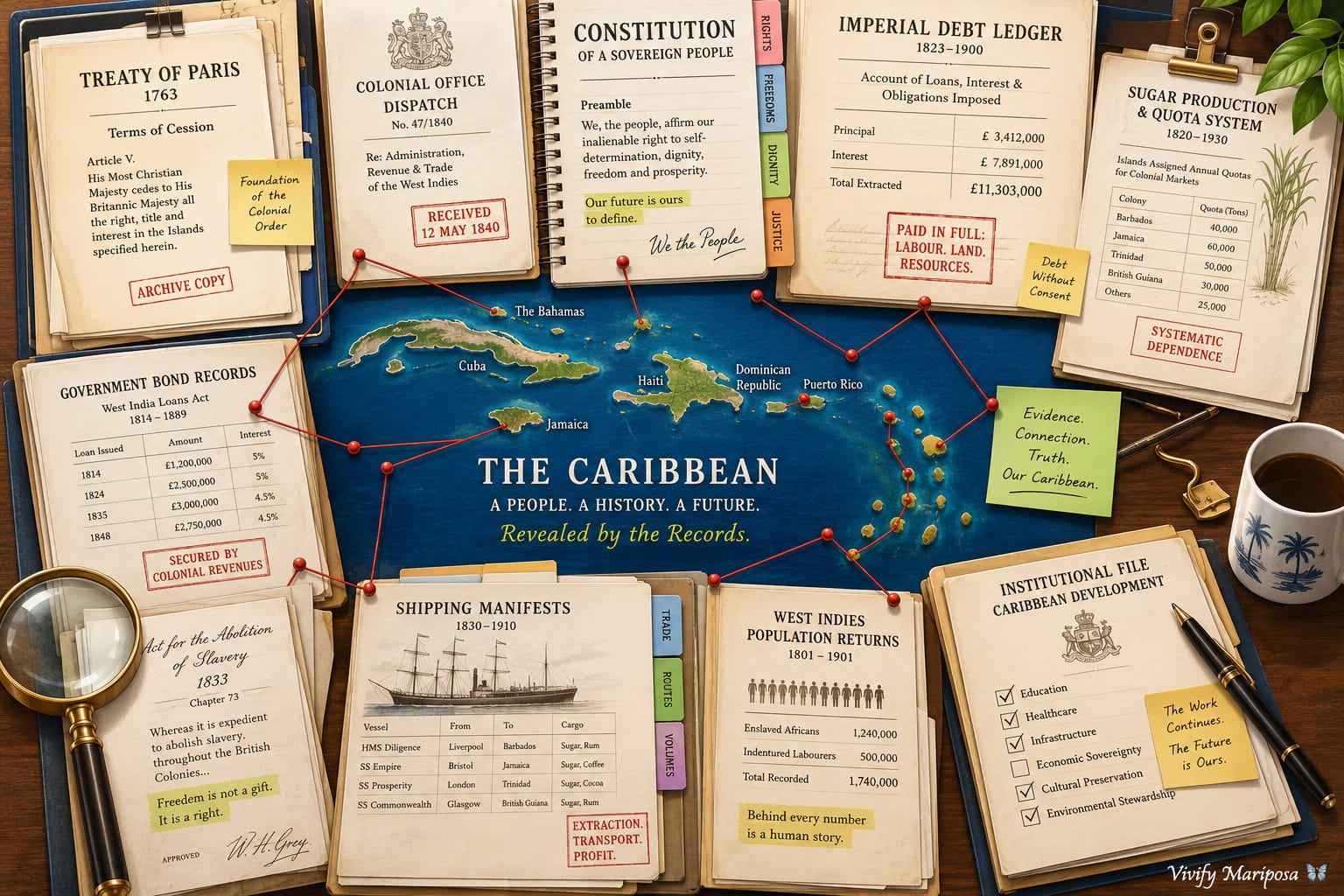
Puerto Rico’s story as taught is a commonwealth with self-governance navigating the challenges of economic transition. The story the documents show is a territory whose constitution was written to guarantee creditor payment before citizen services, whose bankruptcy protection was explicitly removed by Congress in 1984, and whose fiscal decisions were transferred to a board appointed by a Congress its population cannot vote for.
Grenada’s story as taught is a democracy restored after a communist government collapsed from within. The story the documents show is a government removed four days after its leader was executed by its own internal faction, by a U.S. military operation whose strategic purpose was eliminating Cuban influence in the Eastern Caribbean, followed by the installation of a government compatible with the financial architecture.
The CBP Withhold Release Order documenting forced labor at Central Romana is a government document. The IMF Press Release PR/09/393 approving the 2009 Stand-By Arrangement is a government document. The Dominican Republic 2010 Constitution Article 7 is a public document. The FRUS 1958-60 Volume VI Document 544 recording that the 1960 law forced replacement sugar purchases from the Dominican Republic is a declassified government document. The Eisenhower presidential proclamation fixing the Cuban quota at zero in January 1961 is a public document at the American Presidency Project. None of these are hidden. All of them are the history that was not taught.
My friend checked the history and found the labels. The labels are real. The parties are real. The elections happened. The constitutions were written. The governments governed. None of that is false. What the labels cannot show is that the sequence ran the same way under every label. The working class share of national income declined across every government.
The Caribbean was not confused by accident. It was taught the wrong dictionary on purpose.
That is the Caribbean. Not the one that was taught. The one that is in the records.
If this work made you think harder than the approved narrative allows, become a paid subscriber and help keep the research going.
Not ready for a subscription? Support with a coffee.
Thanks for reading! This post is public so feel free to share it.
Vivify Mariposa 🦋 No Filter. Just Facts.
nofilterjustfacts.substack.com
Vivify,
I have loved hearing from you in your interviews on Rich Does Politics YT channel and here on Substack. I think you are an important voice that needs to be heard while developing the new policy approach toward the Caribbean. If we are all on one team in our hemisphere, then we need to be all on one team! Make the Caribbean great! There needs to be a good explanation to people about why Cuban communism happened and how we don’t want to repeat that by developing policies that are fair to the Caribbean nations so they can develop as well!! Let’s try to promote Vivify’s articles to people in the administration who are developing our policy toward the Caribbean. This is such a good analysis. Usually it just demonizes the United States, which makes a lot of people ignore it, and there is a huge problem with how we dealt with them but when you look at the economic structures and you describe so well how that came from city of London no wonder this happened and Trump is trying to break that down so hopefully we can develop a new and better policy. I hope you can be part of it!!
It's the eternal battle Sister. You are doing such an excellent job bringing Your experience of keeping all Humanity free from the evil that never sleeps and wants to destroy our creation. The Universe Blesses you along with myself.